What Is a Career Pathway? How Education Leads to Work
Capstone · November 14, 2026
What is a career pathway? A structured route linking education, credentials and jobs, with real examples and how to map yours.
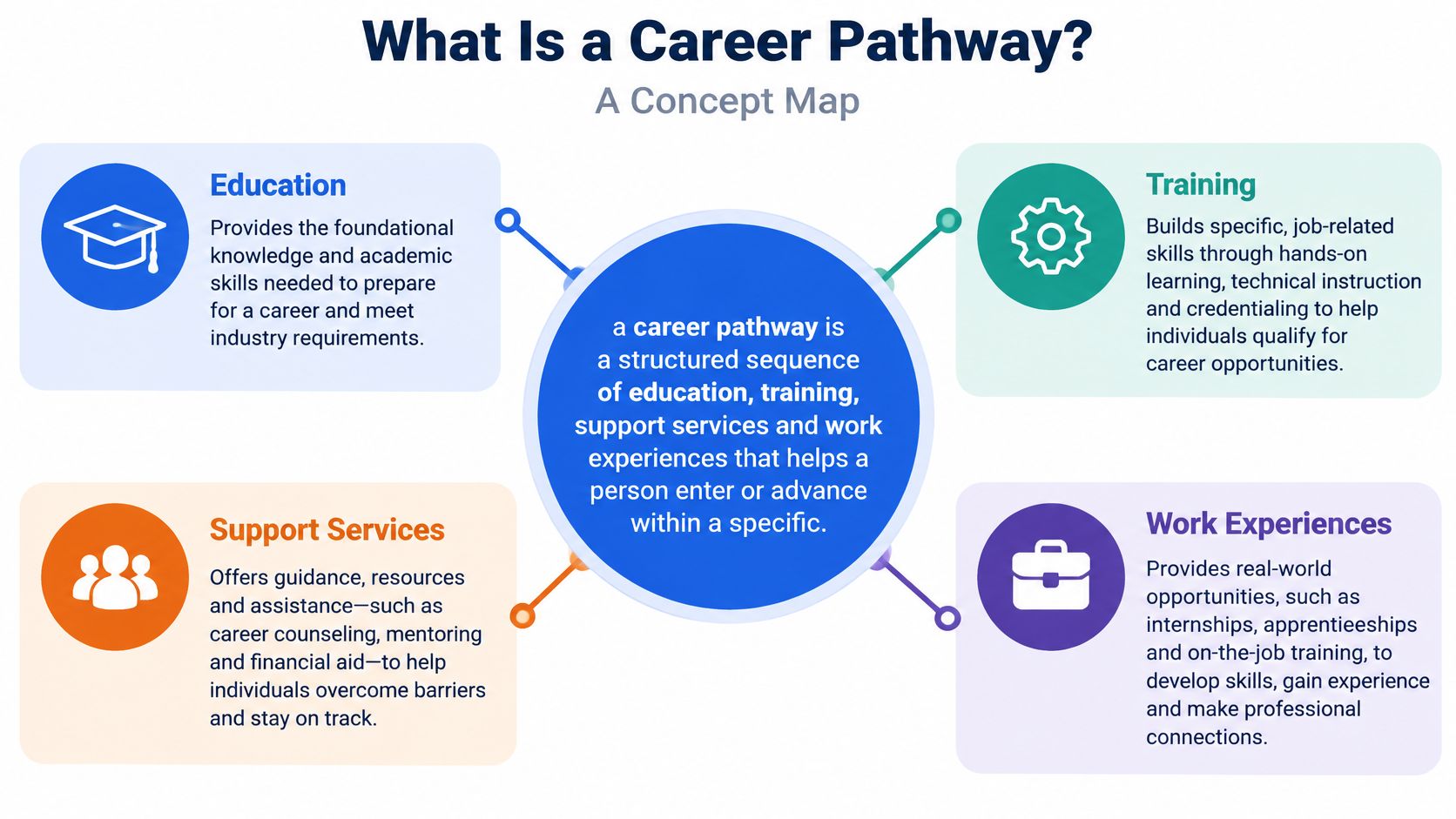
A career pathway is a structured sequence of education, training, support services, and work experiences that helps a person enter or advance within a specific occupation or occupational cluster. In the United States, the Workforce Innovation and Opportunity Act, enacted in 2014, hangs that sequence on three milestones: a secondary-school diploma or a recognized equivalent, at least one recognized postsecondary credential, and entry into or progression within a targeted occupation.
So here's the question worth carrying through everything below. When a program says a certificate "opens doors," which door opens, how far, and what does the person standing on the other side earn? Most explanations of career pathways answer the definition and skip the test.
This guide goes the other way. A pathway is a set of transitions you can check before you spend money: what the entry requirement is, who hires at the end, what the step above the first job looks like, and whether people move from one rung to the next. Some of those answers are encouraging. Some are thinner than the marketing suggests, and the federal evidence on earnings is one place where the honest answer is "less than you'd hope."
Table of Contents
- A Career Pathway Defined in One Sentence
- How the Stages Connect Over Time
- The Four Parts Every Working Pathway Needs
- A Worked Example From Nursing Assistant to RN
- What Pathways Do and Do Not Deliver
- Who Can Follow a Pathway and How to Map Yours
A Career Pathway Defined in One Sentence
The definition is one sentence long and unusually precise. A career pathway is a structured sequence of education, training, support services, and work experiences that helps a person enter or advance within a specific occupation or occupational cluster. The last six words do the work: an occupation, not education in general, and advance, not just enter.
Compare a trail map with a list of mountains. A list of mountains gives you destinations and nothing else. A marked trail shows the junctions, how long each segment takes, and where each branch comes out. A pathway is the marked trail. A list of in-demand occupations is the mountains.
The formal version comes from federal statute. The OECD education working paper on career pathways15/en/pdf) sets out the definition the Workforce Innovation and Opportunity Act established in 2014, and it names three connected milestones: a secondary-school diploma or recognized equivalent, at least one recognized postsecondary credential, and entry into or progression in a targeted occupation. Notice that every milestone is checkable. You either hold the credential or you don't.
Three features separate a pathway from a training catalog: alignment with a named occupation, progression between steps, and a measurable connection between learning and employment. A route might run from secondary coursework to a short-term certificate, into an entry-level job, then further technical training, then a higher-skilled role.
One question filters most of the noise around what is a career pathway claims: which named job does this lead to, and what is the clear step above that job? If the provider can't answer both, you're looking at a course, not a route.
A pathway also isn't a career ladder. A ladder ranks positions inside one employer and depends on that employer's promotion rules. A pathway connects education and credentials to occupations across employers, so the credential travels with you when you change jobs. If you're weighing technology roles, tech career path guides are a useful worked example of how those routes branch and rejoin.
How the Stages Connect Over Time
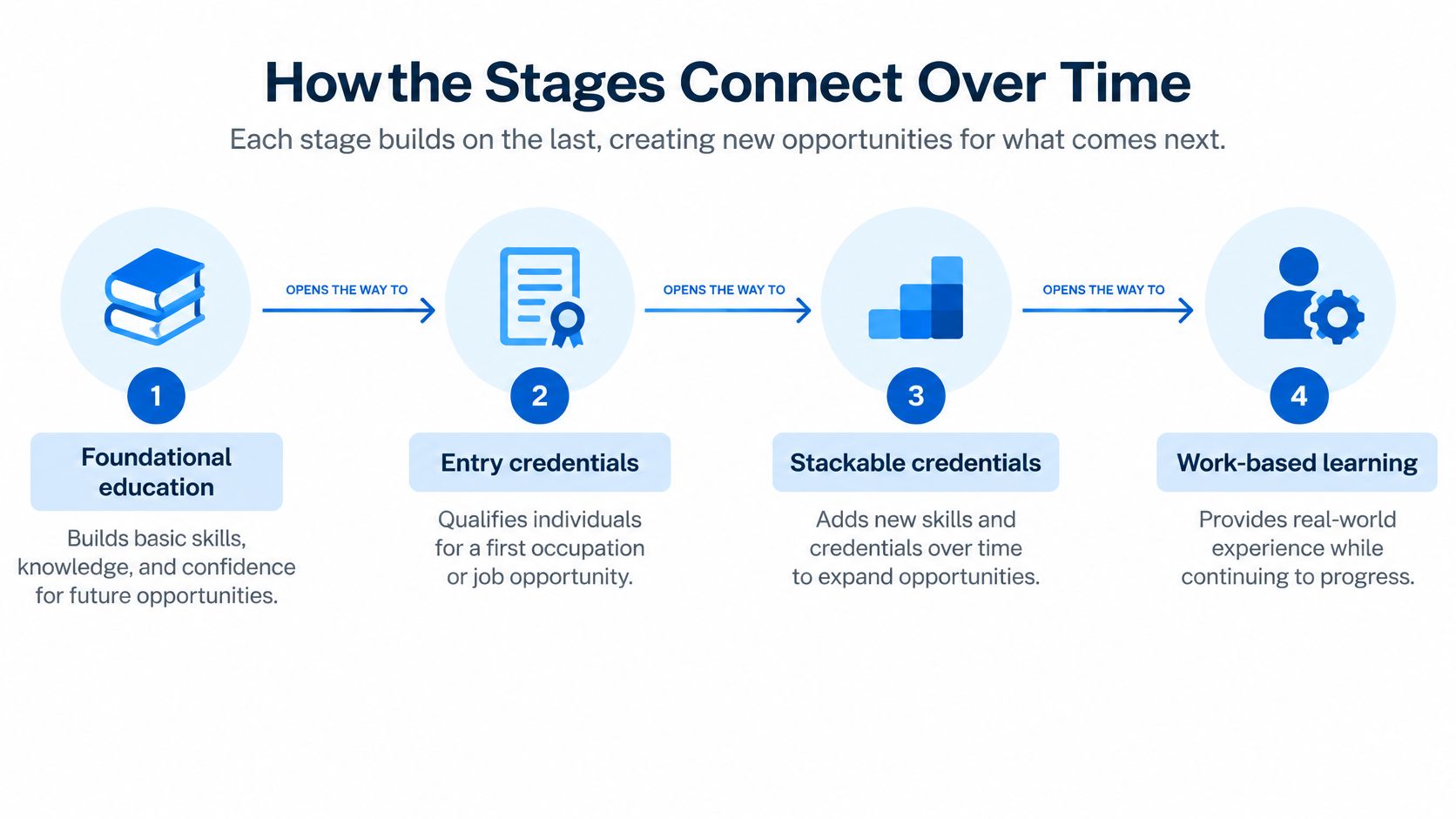
A pathway holds together because of sequence. Foundational education and an entry credential open the door to a first occupation, and stackable credentials plus work-based learning create recognized moves into higher-skill roles. The U.S. Department of Labor frames these as connected education, training, and support strategies that enable industry-relevant certification, employment, and advancement within an occupational area.
The diagram below shows the same progression, with each stage opening the next.
What Each Stage Has to Prove
A stage that names only a course is a course. Real stages carry six details: entry requirements, the competencies taught, the credential awarded, employer demand for that credential, the expected wage, and the supports that get someone through. Remove any one of them and the route breaks at the join.
| Stage | What the learner completes | What it unlocks | What to verify |
|---|---|---|---|
| Secondary diploma or equivalent | High school diploma or recognized equivalent | Entry to postsecondary training | Entry rules of the next program |
| Entry credential | Short-term certificate or license | First job in a targeted occupation | Employer demand and starting wage |
| Work-based learning | Registered apprenticeship or paid internship | Skills tied to a real employer | Completion supports and pay during training |
| Stackable credential | Additional technical certificate | Higher-skilled role | Recognition by employers in the field |
| Advancement role | Promotion or move to a new employer | Wage progression | Expected wage at each stage |
Two things are easy to miss in that table. Registered apprenticeship is one form of work-based learning, and it pays while it trains, which is why it sits inside the route rather than beside it. Several stages can also run alongside paid work, since a stackable certificate earned on evenings and weekends still counts as a stage.
This short video walks through how the pieces fit together in practice.
Plan Backward, Check Forward
Start from the job you want in five years and walk back. What does that role require for entry? Then confirm that the output of each earlier stage is the entry requirement of the stage after it. Where the two don't meet, you've found the break in the route before you've paid for it.
Write it down: Take one occupation you're considering and fill in the same four columns for it. The cells you can't fill are the exact questions to put to a local workforce board.
The Four Parts Every Working Pathway Needs
A pathway works like a relay race. Each stage has to hand off cleanly to the next, and the exchanges are where races are most often lost. Four components decide whether those handoffs happen, and each one is a test you can run before committing time or money.
- Industry alignment: the training matches skill demand in the region where you plan to work. A certificate for a shrinking local industry is a dead end however well it is taught. The quick test is whether nearby job postings name the credential.
- Connected transitions: secondary or adult education links to postsecondary credentials and registered apprenticeships, so finishing one level is the ticket into the next. When this part works, the completion document from stage one is the admission requirement for stage two.
- Supports that remove barriers: tuition help, transportation, childcare, and schedules built around work. Without them, the sequence filters out everyone who lacks savings and flexible hours.
- Employer connections: work experience, real interviews, and employer input on what the curriculum covers. Employers who help design the training tend to hire from it, which turns the final stage into an audition you have already passed.
Planning around those four parts has measurable value, though the measurable part is narrower than most summaries suggest. OECD analysis of career guidance ties career development around age 15 to better employment outcomes around age 25, so the effect of early route planning can stretch across roughly a decade. What the wider evidence supports is that guidance is associated with better outcomes. It does not certify that any single route will pay off, which is why the four checks run before you enroll.
A pathway is a working hypothesis you retest every time conditions change.
Markets shift, credentials get retired, and a route that made sense in one hiring cycle can stall in the next. Treat the four parts as a feasibility test and run it again after a move, a layoff, or a new credential. If a program is missing two or more, the gap is yours to close.
A Worked Example From Nursing Assistant to RN
Say you start as a nursing assistant. Certified nursing assistant training plus a state competency exam can put you in entry-level patient-care work in a short timeframe, earning while you decide whether clinical work suits you. That first credential is the cheapest possible test of the career, which is exactly what a pathway stage should be.
The next stage is practical nursing. LPN training typically takes about a year, ends in licensure, and moves you into supervised practical nursing roles with more responsibility and better pay. From there, registered nursing usually means an associate degree program of about two years, or a bachelor's degree that takes longer, followed by RN licensure.

Why Stacking Beats Restarting
The point of the sequence is that you don't begin from zero each time. Where bridge agreements exist between programs, a CNA's patient-care experience and completed coursework count toward the next credential instead of being discarded. That's what "stackable" means in practice, and it's the difference between a pathway and three unrelated enrollments.
| Stage | Credential | Typical time | Next step |
|---|---|---|---|
| CNA | Certified nursing assistant training and state competency exam | Short timeframe | Entry-level patient-care work |
| LPN | Practical nursing training and licensure | About a year | Supervised practical nursing roles |
| RN (associate) | Associate degree and RN licensure | Two years | More advanced registered nurse roles |
| RN (bachelor's) | Bachelor's degree and RN licensure | Longer than two years | Advanced registered nurse roles and leadership |
Requirements vary by state and by program, so confirm each entry rule locally before you enroll. Funding rules vary too, and WIOA-funded nursing programs are worth checking if cost is the barrier.
The same pattern shows up outside healthcare. In manufacturing maintenance, a technical certificate gets you into a technician role, machine-specific experience builds from there, and the move into supervision usually runs through demonstrated troubleshooting rather than a second degree. Trace one example for yourself, naming the credential, the time, the job, and the next step at each stage.
What Pathways Do and Do Not Deliver
Judge a pathway the way you would judge any education-and-employment intervention: on whether people finish, get hired in the target field, stay, and move up. Brochure promises do not count. Measured outcomes do.
Those measured results are more mixed than most program materials admit. The U.S. Department of Labor's meta-analysis of 46 career pathway impact evaluations found that credential receipt increased by 155% and employment in targeted industries rose by 72%, while overall employment gained only 9%. The same review reported small short-term earnings effects and no meaningful medium- or long-term earnings effects.
Read those numbers together and the lesson is clear. Pathways reliably do what they are designed to do, which is produce credentials and place people into the targeted industry. They do not automatically lift total employment or long-run pay. That distinction matters when you weigh the cost of a program against the outcome it can promise.
Where Maps and Real Moves Diverge
A second gap sits between the diagram and how people change jobs. Workers move between roles using tacit skills, social networks, economic necessity, and employer-specific experience, and formal pathway maps leave all of that out. SREB's 2025 career pathway handout notes a mixed pattern across business, sales, finance, and green occupations, where some roles have few obvious adjacent moves and the printed route is rigid.
So treat every arrow on a pathway map as a hypothesis to test before you pay for it. Does the next credential feed into local job postings, or is the move mostly theoretical on paper? Guidance that labels an occupation "next" without explaining how hard the transition is can push people into expensive training that never improves their mobility. A more useful framing separates credential progression from employment progression, then names the alternative routes: employer-based learning, lateral moves, and a portfolio of demonstrable skills.
Practical rule: Track credential completion, occupational placement, retention, wage progression, and advancement as five separate numbers. Enrollment counts tell you nothing about any of them.
Flexibility deserves the same scrutiny. Evening classes and open sequencing remove friction, but convenience alone is not a strategy; a program still lives or dies on employer alignment and completion support. If cost is the sticking point, this guide to paying for training covers the funding routes, and this overview of career development pathways that work is a sound second read on what separates the programs that place people from the ones that do not.
Who Can Follow a Pathway and How to Map Yours
Feasibility comes before interest. A 2025 CIPD report on lifelong learning in the reskilling era shows how sharply mobility narrows with age: job-to-job transitions fall from about 18% among 20-year-olds to 5% among 60-year-olds, while occupational changes drop to roughly 2% at age 60. Perceived opportunity falls too, with nearly 60% of workers aged 18 to 34 reporting good opportunities to advance, against 32% of those aged 45 to 54 and 24% of workers over 55. The same evidence names lack of time, financial resources, and employer support as the main barriers to lifelong learning.
That's why pathway awareness and pathway feasibility are different problems. Knowing the steps doesn't tell you whether you can absorb unpaid classroom hours, tuition, transport, caregiving demands, or lost income. A route you can't afford to walk isn't a route.
Five Actions to Map Yours
- Name one target occupation or occupational cluster. Not an industry, not a "field." One occupation with a job title you can search.
- Fill in the details for every stage. Entry requirements, credential, expected wage, time to complete, and whether it can be done while working.
- Check how often people move up. Local workforce data and job postings show whether the next step is common or rare in your area.
- Ask the provider two direct questions. Which credentials stack into the next program, and which outcomes do they track after completion?
- Pick the first stage you can finish in the next three months, then set a review date. Momentum matters more than the perfect plan.
If you have caregiving duties or limited hours, start with the shortest stackable credential and confirm the class schedule before you enroll. Our career assessment is one option for action one: it asks a few questions and shows the jobs that fit you, with the pay and training for each. We also work with people making harder transitions, including transitioning service members, military spouses, career re-entry after a gap, returnship candidates, industry pivots, and returning citizens.
Transparent credential data still doesn't make a route affordable, and no tool changes that on its own. Verify every pay and training figure with your local workforce board, because boards control funding eligibility and their local rules beat anything published nationally.
Capstone Workforce is built for the part after the definition: choosing a target job, finding the training that leads to it, and getting through the credential. Our career tool shows matching jobs with their pay and training requirements, our funding guides explain WIOA and other ways to cover or get paid during training, and our certification prep covers written practice tests and hands-on skills for exams including CNA. Start at Capstone Workforce and map the first stage you can finish this quarter.