Skills Assessment Tests Explained: Formats and Scoring
Capstone · November 13, 2026
Learn what skills assessment tests measure, the main formats, how scores are read, and how employers and workforce programs use the results.
The email arrives two days before the interview. A link, a timer, and one line of instruction: complete the skills assessment before your call. Nothing about what's on it, nothing about what a good result looks like. You open the practice tab, watch the clock, and wonder whether any of this measures what the job requires.
That's the right question. A skills assessment test earns its place only when its tasks match the work you'd be doing on an ordinary Tuesday, not the work of answering questions quickly. The format, the percentile, the pass mark, all of that is machinery wrapped around that one match.
People treat a score as a verdict on their ability. Often it's a verdict on how well they performed a particular format. Separating those two things is the whole skill, and it's learnable.
Table of Contents
- What Skills Assessment Tests Actually Measure
- Test Formats Compared Side by Side
- How Scores Get Read Against People or Standards
- Why Tests Are Moving Online and Adapting
- When a Good Score Does Not Predict Good Work
- Where Employers and Programs Use the Results
- Choose the Right Assessment for Your Goal
What Skills Assessment Tests Actually Measure
A written driving quiz asks what a speed limit sign means. The road test asks you to merge into traffic while a stranger in the passenger seat takes notes. Skills assessment tests sit closer to the road test. They check whether someone can carry out a defined task, not whether that person can recall the task exists.
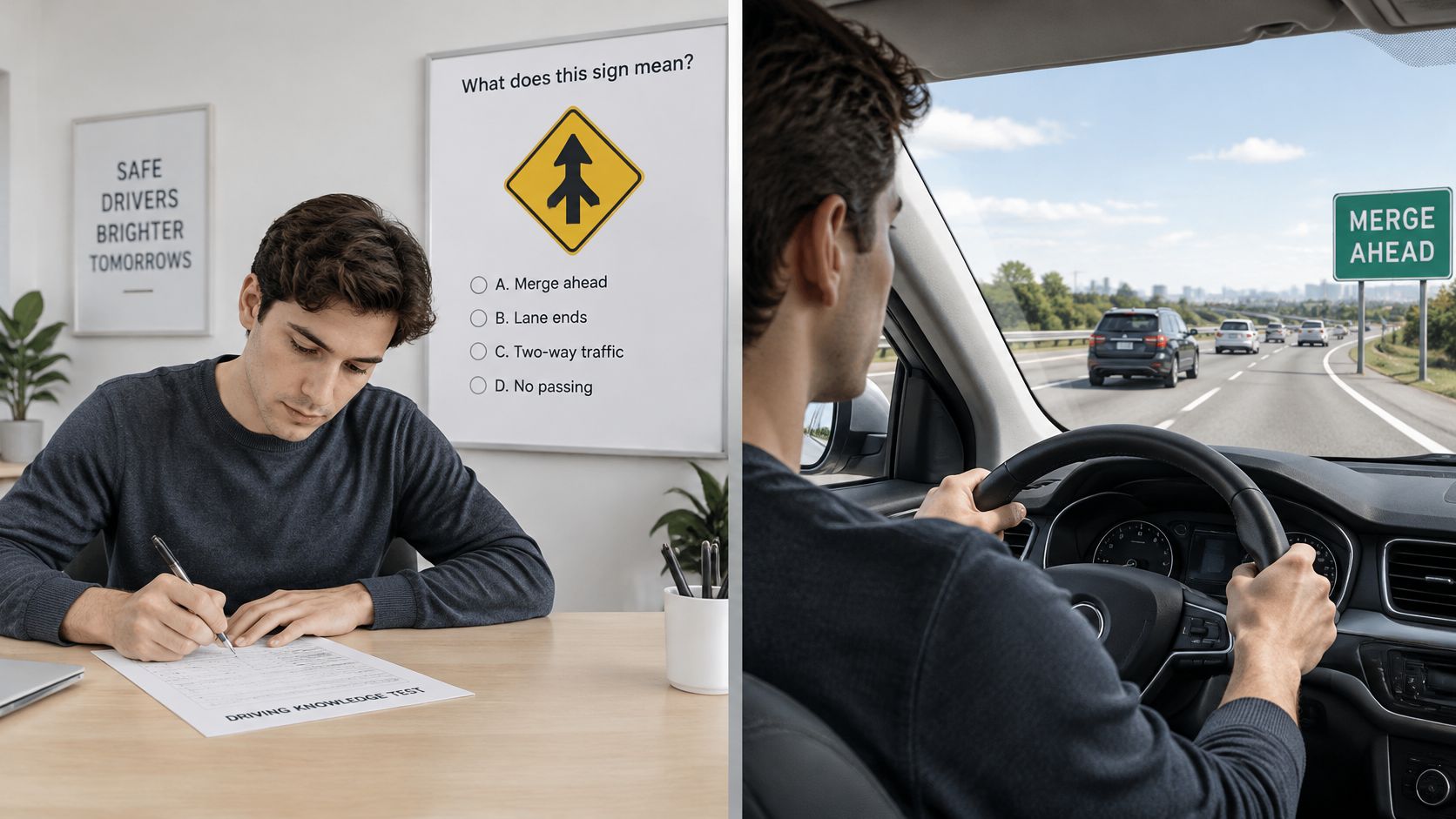
That distinction sounds academic until you're the one holding the results. A candidate who freezes under a timer can be perfectly capable on the floor. A candidate who scores well may be good at the format.
The three things a test can measure
Almost every assessment you'll meet measures one of these, or a blend of all three.
- Knowledge: terms, rules and procedures. A pharmacy technician knows which medications need refrigeration. A driver knows what a solid yellow line means.
- Applied skill: using that knowledge to finish a task. An office candidate builds a pivot table and types at a steady rate. A care worker calculates a dose from a chart without help.
- Work behaviour: judgement, communication and pacing under pressure. A shift supervisor gets a situational test about a teammate who keeps arriving late. The score reflects the choice made, not the vocabulary used.
The name on the invitation tells you very little
"Skills assessment" is a label, not a specification. It covers a 15-minute typing check, a two-hour simulation and a live practical exam where an assessor watches you work. Two tests with identical names can measure entirely different things, so the content outline is the document worth reading closely. Look for what the test asks you to do.
The pull toward these instruments is strong. The World Economic Forum's Future of Jobs Report 2025 found that 48% of employers expected to use skills assessments to evaluate candidates during hiring in 2025. Whether that testing measures anything useful depends on what's inside it, which is why the employability skills employers actually screen for are worth studying before you sit one.
Everything comes down to three things: what the format asks of you, how the score gets read, and whether the tasks match the job.
Test Formats Compared Side by Side
Two assessments can both be called a skills test and ask completely different questions about you. One wants to know what you remember. The other wants to know what you do when the clock starts.
Common skills assessment test formats
| Format | What It Measures | Typical Setting | Main Limitation |
|---|---|---|---|
| Multiple-choice knowledge test | Terms, rules and facts | Certification prep and entry screening | Shows recall more than doing |
| Timed aptitude or reasoning test | Speed and accuracy on reasoning or numeric items | Graduate and entry-level hiring | Speed favours some candidates over others |
| Work sample or simulation | Performance on a realistic task | Trades, clerical and service roles | Costly to build and score |
| Practical skills exam | Hands-on procedures under observation | Licensing, such as driving or clinical skills | Depends on scheduling and assessor consistency |
| Situational judgement test | Choices in workplace scenarios | Supervisor and customer-facing roles | Answers can be coached |
| Spoken or written scenario response | Communication, structure and composure | Interview and promotion preparation | Needs a clear rubric to score fairly |
| Software or typing proficiency test | Speed and accuracy in named tools | Office and data roles | Tests the tool rather than judgement |
A multiple-choice knowledge test is the cheapest format to build and the easiest to prepare for. It handles rules and vocabulary well, which is why licensing bodies use it as the first gate. It tells you little about whether someone applies the rule when a customer is upset.
Timed aptitude tests measure speed and accuracy on reasoning or numeric items. Graduate schemes lean on them heavily. The fairness problem is built in: a careful thinker who needs 40 seconds where others need 15 loses points on a trait the job may never require.
Work samples and simulations hand over a realistic task, such as reconciling a batch of invoices or handling a scripted complaint. Clerical, trades and service employers use them because performance becomes visible. Building and marking them takes money and time.
Practical skills exams put you under observation. A forklift operator evaluation is the clean example: the assessor watches you inspect the machine, pick a load and set it down, and the score reflects what happened in front of a witness. Scheduling and marker consistency are the soft spots.
Situational judgement tests present workplace scenarios and score your chosen response. Supervisory and customer-facing roles use them. Prep books exist for a reason, so a strong result may reflect rehearsal rather than judgement. Spoken or written scenario responses capture communication, structure and composure, and they need a written rubric or two assessors will score the same answer differently. Software or typing proficiency tests measure speed and accuracy in named tools, which office and data roles require, and say nothing about when to use those tools.
The mapping rule: if the job is hands-on, look for a work sample or practical exam. If it's customer-facing, expect a situational or spoken format. If it's a licence, expect a knowledge test plus a practical exam, and prepare for them separately.
How Scores Get Read Against People or Standards
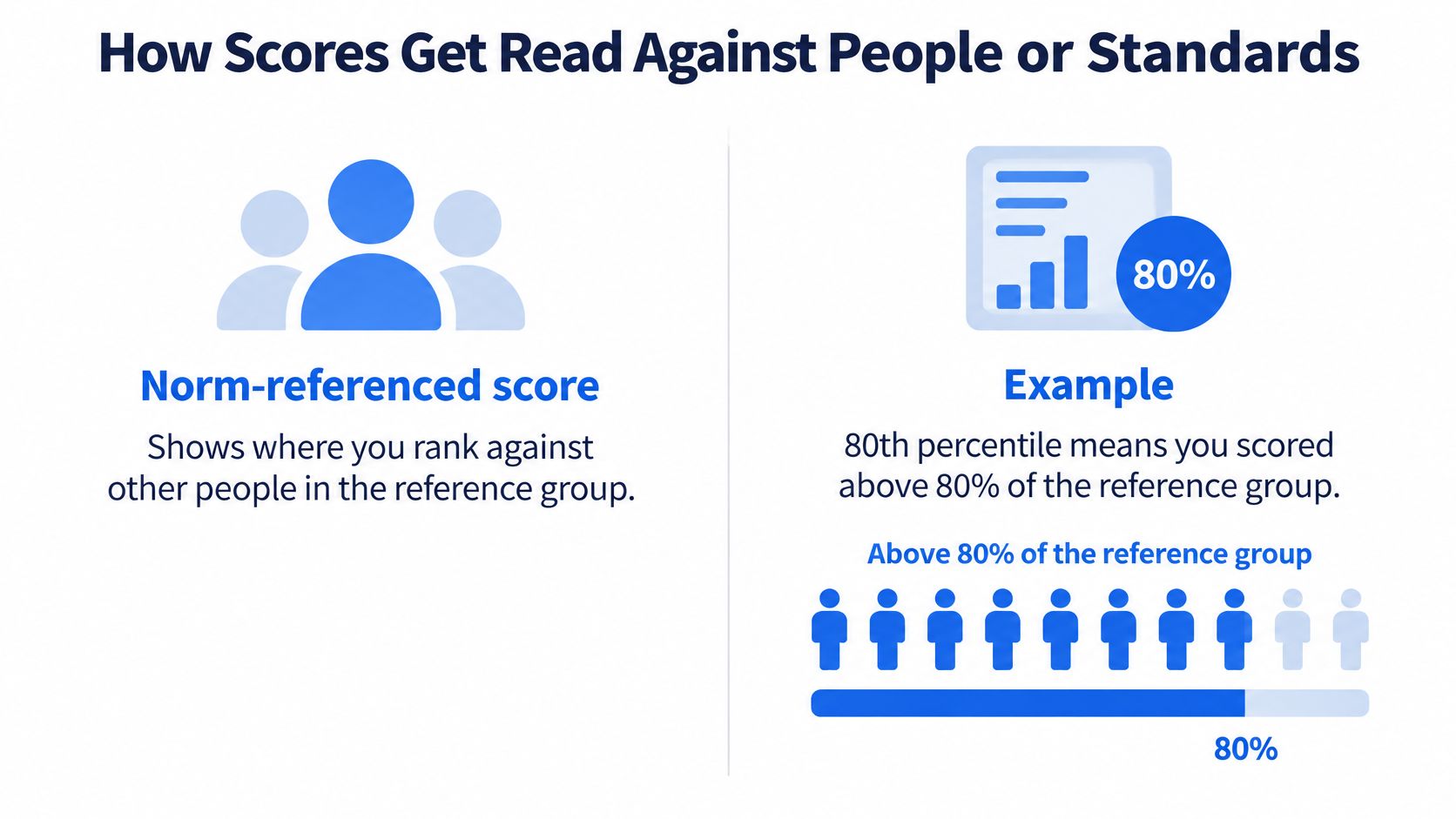
A score of 78 means nothing on its own. It could mean you outperformed three quarters of the people who took the same test, or that you cleared a pass line set by a licensing board. Those are different claims, and mixing them up is the most common misreading of a result.
Ranking against people
Norm-referenced scoring puts you in a line. Say 200 people sit the same test and you land at the 80th percentile. Roughly 160 of them scored below you, which puts you in the top fifth of that group. The number describes your position, not your competence, and it shifts with the group. Sit the same paper against a stronger cohort and identical answers produce a lower percentile.
Measuring against a standard
Criterion-referenced scoring asks whether you met the standard. A licensing exam with a 70% pass line judges you against a defined body of knowledge, and the whole room can pass together or fail together. Robert Glaser formalised criterion-referenced testing in 1963 to evaluate what an examinee could do without ranking that person against others, as this historical review of criterion-referenced testing records.
Rubrics carry the same logic outside licensing. An assessor rates your answer 1 to 5 against written descriptors for each competency, so the question becomes whether the answer met the descriptor for a 4, not who was best that morning. A published communication rubric scoring method shows how that structure holds up when someone audits it.
Where the two collide
A candidate at the 30th percentile can still pass an absolute standard. A candidate near the top of the ranking can miss the same pass line. Neither outcome is contradictory, because one measures position and the other measures sufficiency.
Read any result in three steps: find the scale being reported, check whether a cut score or pass standard exists, then identify the reference group and decide whether it resembles your situation.
Why Tests Are Moving Online and Adapting
The first block of questions feels manageable. The second block is harder. By the third, the difficulty eases back. Nothing has broken. The test is routing you, picking each next set from how you handled the last one.
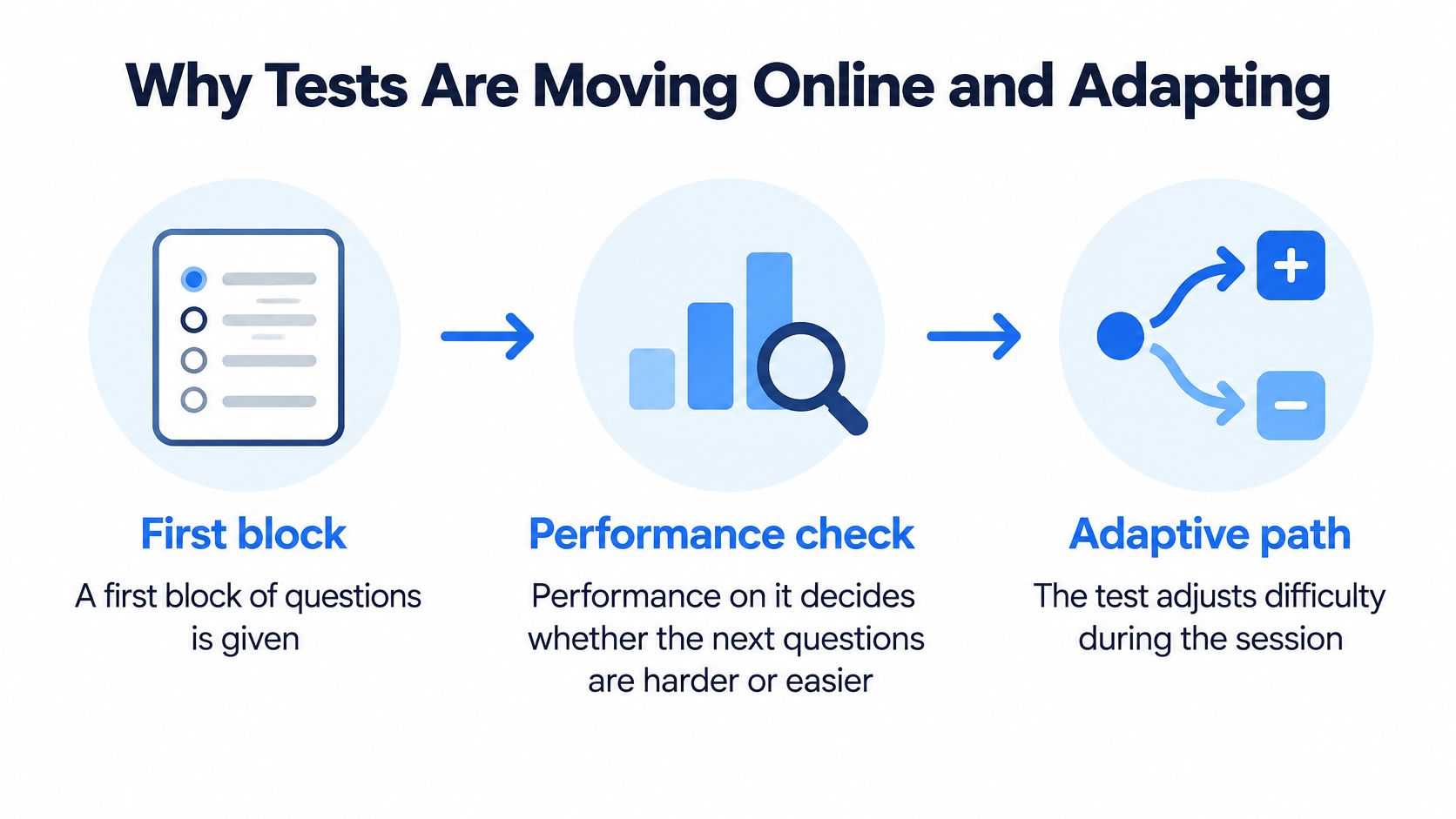
Large programmes have run this way for years. The OECD launched its Programme for International Student Assessment in 2000 with 32 countries and economies, and by the 2022 cycle around 690,000 students took part, representing about 29 million 15-year-olds across 81 participating countries and economies, with most sitting computer-based tests of roughly two hours. According to the OECD's PISA 2022 technical report, adaptive testing arrived for reading in 2018 and mathematics in 2022, with later blocks assigned according to performance on earlier blocks, a design meant to measure students across a broad range of ability more efficiently and precisely than fixed test forms.
For a workforce test, that routing buys something concrete. A shorter session can still locate your level, and the pattern of right and wrong answers points to specific gaps rather than one undifferentiated number. A preparation plan built on those gaps beats a plan built on a single total.
Here's how the routing looks in practice, from the test-taker's side.
Two practical points follow. Expect the difficulty to move, and don't read a sudden hard patch as failure, because that's the design working. Expect also that many adaptive tests won't let you return to earlier items, since your path through the item pool is already set.
Put three questions to whoever runs the session before you start: is the test fixed or adaptive, how long does it run, and can I revisit items I've already answered?
When a Good Score Does Not Predict Good Work
A test can be perfectly consistent and still tell you nothing about the job. That's the gap between reliability and validity, and most assessment conversations blur it. A reliable test gives the same result on a retake. A valid test measures something the work demands.
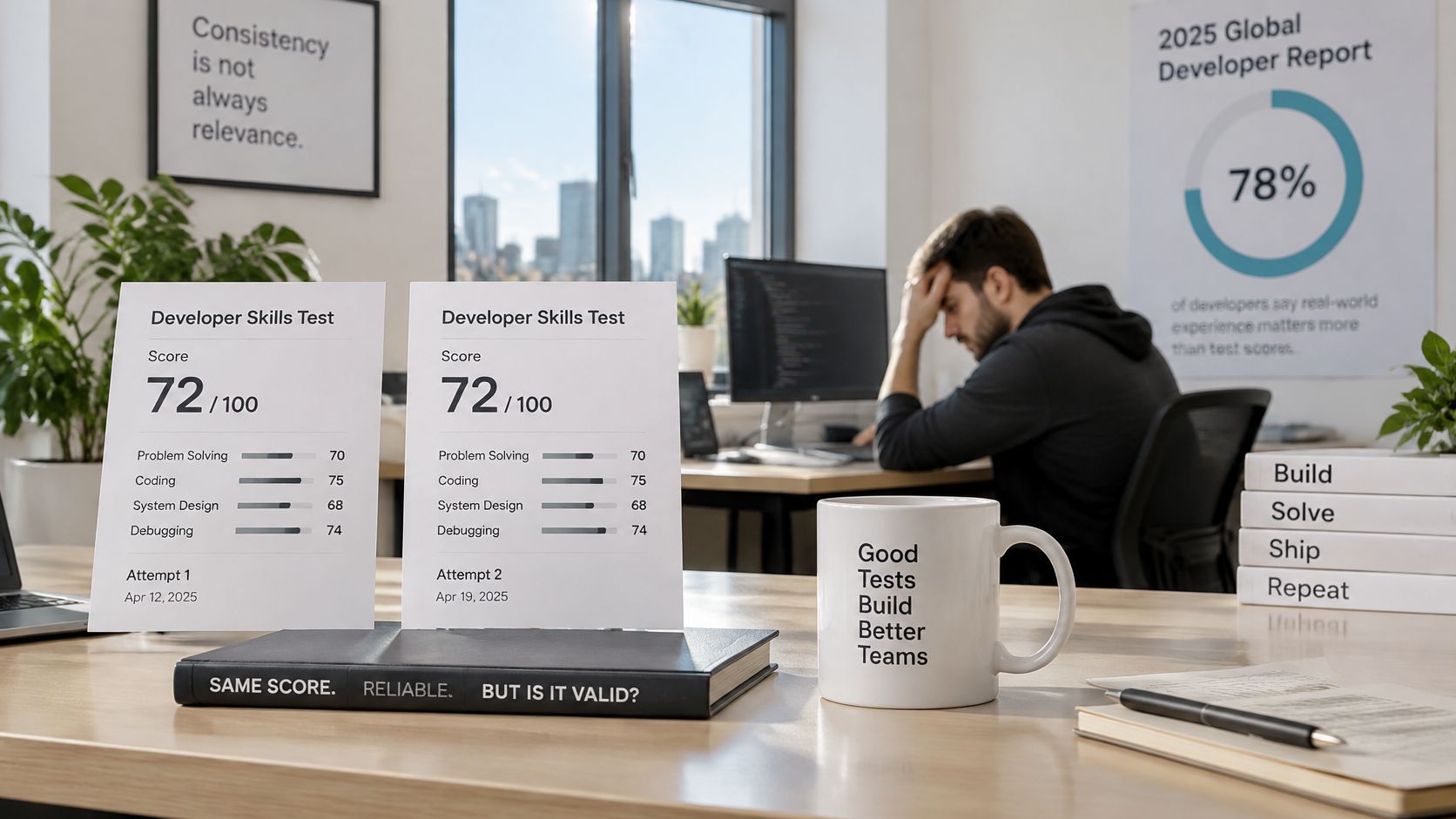
Candidates notice the mismatch. HackerRank's 2025 developer skills report found that 78% of developers believed assessments did not align with real-world tasks, while 56% considered algorithm-based questions irrelevant to their jobs. Those respondents weren't saying the tests were unfair. They were saying the tests measured something else.
Two mismatches you can spot quickly
A timed logic puzzle measures puzzle speed. It says nothing about whether someone can maintain a working codebase, read a stack trace or ask a colleague the right question before shipping. A typing test measures words per minute. It says nothing about how a person handles a customer who has been on hold for 20 minutes and wants a refund nobody can authorise.
Neither test is worthless. Both are being asked to carry a claim they can't support.
Where the score gets distorted
- Unfamiliar formats depress results even when the skill is present. Someone who has never used a drag-and-drop coding environment loses minutes to the interface.
- Missing accommodations turn a solvable task into a failed one. Reasonable adjustments exist for a reason, and requesting them is not a confession of weakness.
- Coaching effects inflate scores without building skill. A candidate drilled on situational judgement patterns can score highly and still make poor calls in week one.
When the risk of a wrong hire matters more than screening volume, a work sample, a structured interview with the same questions for everyone, or a practical demonstration under observation will tell you more than a generic cognitive test. Keep the generic test if it's cheap and early, but don't let it decide alone.
The alignment test: list the tasks the job requires, match each test item to one of those tasks, then count how many items measure the format instead of the job. That count is your answer.
More testing isn't automatically better testing. Alignment, consistent scoring and realistic conditions are what make a result mean something.
Where Employers and Programs Use the Results
Assessment has moved past hiring. Mercer's 2024/2025 Skills Snapshot Survey Report found that in 2024, 33% of organisations conducted skills assessments annually and 21% ran them continuously. Continuous use is the interesting number, because it means results now feed decisions long after an offer letter.
Who uses assessment results and what they decide
| Who Uses Results | Decision the Score Drives | Good Practice | Question to Ask |
|---|---|---|---|
| Employers in hiring | Shortlist or advance candidates | Job-linked tasks with the same conditions for everyone | What does this test measure for this role? |
| Internal promotion panels | Choose which employee moves up | Same questions and rubric for every candidate | Will I get feedback if I am not selected? |
| Certification bodies | Pass or fail for a licence or credential | Published pass standard and clear retake policy | What is the pass mark and how many retakes are allowed? |
| Grant-funded workforce programs | Place participants and track progress | Documented outcomes and readiness checks | How will my results shape my training plan? |
| Schools and training providers | Place learners and plan support | Results matched to course entry levels | Which skills need work before the course starts? |
| Job seekers | Choose what to practise next | Score mapped to specific skill gaps | Which gap should I work on first? |
The promotion panel deserves a closer look, because that's where a score does the most social damage when handled badly. Say four internal candidates interview for one supervisor role and the panel scores all four on the same scenario questions with the same rubric. Three people will be disappointed. Each one should leave with a specific sentence about what separated them, whether that's pacing under pressure, structuring an answer, or handling the moment a direct report pushed back. A rejection with no detail teaches nobody anything and costs you a good employee.
For employers, the practice that makes a result usable is boring and essential: identical questions for every candidate, a written rubric applied by more than one marker, and a documented record of why the decision landed where it did.
For job seekers, the useful move is to ask what happens after the score. A result that routes you into a training plan or a specific practice set has value even when the number disappoints. A result that ends the conversation has none.
Choose the Right Assessment for Your Goal
Your next step depends on why you're being assessed.
If you're job hunting, pull the tasks out of the posting first, then find a practice format that copies them. The free 5-minute assessment from Capstone Workforce shows jobs that fit you, with pay, training and openings near you, and it needs no account.
If you're preparing for certification, separate the written test from the practical exam and rehearse both. They fail for different reasons.
If you want to practise speaking under pressure first, the free Customer Service interview practice tool asks you to answer question 1 out loud and returns a score.
If you run a programme or a small company, book the 30-minute walkthrough, where the team runs a live scored mock interview on the rubric, shows the manager dashboard and steps through the WIOA-aligned outcome export. One boundary worth knowing: local workforce boards, not a software provider, decide public funding eligibility.
The four-step checklist: confirm the tasks the test measures, confirm the scoring standard, confirm what happens after the result, then take a first practice attempt before the real one.
Capstone Workforce exists to make the tasks-and-standard match visible before it costs you an opportunity: scored mock interviews, rubric-based scenario practice and readiness reporting on one published five-dimension rubric, so a score points to something you can work on. If you're preparing for a certification, an interview or a promotion panel, start with a scored practice session and see exactly which gap shows up first. Visit Capstone Workforce to begin.