Resume for Teacher Job: A Step-by-Step Guide for 2026
Capstone · November 16, 2026
Learn how to write a resume for teacher job applications, with a section-by-section layout, classroom impact examples and ATS tips for 2026.
You've found a teaching vacancy that fits, but your resume still reads like a job description: planned lessons, managed behavior, communicated with families. Meanwhile, the district application asks for your credentials again, and you're wondering whether your classroom work sounds specific enough to earn an interview.
A strong resume for a teacher job makes the essential decisions easy for the reader. Can you teach this grade and subject? Is your license appropriate for the position? What evidence shows how you teach? Start with those questions, not a decorative template or a paragraph about your passion for education.
Table of Contents
- Build Every Section of a Teacher Resume in Order
- Turning Classroom Work Into Measurable Impact
- Tailoring Your Resume to Each Teaching Job and Screen
- Mistakes That Get Teacher Resumes Skipped
- Check Your Resume and Send It This Week
Build Every Section of a Teacher Resume in Order
Teacher resume blocks, contents and length
Use these as drafting targets, not rigid limits. Give relevant classroom evidence more space than formatting or general statements.
| Block | What to include | Length |
|---|---|---|
| Header | Full name, email, phone, city and state | 2–3 lines |
| Summary | Certificate, grade band, subject and years taught | 3–4 lines |
| Certifications | License type, issuing state, expiry date or pending status | One line per license |
| Teaching experience | School, dates, grade, subject, class size and results | 3–5 bullets per role |
| Skills | Classroom technology, assessment tools, co-teaching, languages | 6–10 items |
| Education | Degree, institution, year and student teaching | 2–3 lines |
Keep the header in the document's main body rather than placing essential contact information inside a graphic. Use a professional email address and a phone number with a working voicemail. City and state provide location context without using space on a full street address.
Eligibility comes before polish. The OECD's analysis of teacher recruitment and shortages shows how much credential systems and terminology differ from one education system to the next. That variation matters on a smaller scale too. A credential label familiar to one district may not communicate your eligibility to another, so spell out the license rather than relying on shorthand.
Build the Evidence Before the Introduction
Write the summary last, then place it first.
Build your experience section before deciding what deserves the opening lines. Then write a compact summary naming your certificate, grade band, subject, and actual teaching experience. Add a relevant strength, such as literacy intervention or laboratory instruction, supported below. The common slip is opening with enthusiastic adjectives instead of qualifications.For a new teacher, distinguish student teaching from independent classroom employment. For an experienced teacher, name the specialization that fits this vacancy rather than trying to summarize your entire career.
Fill certifications with the exact license name, state, and status.
Copy the credential title from your official record, including relevant endorsements. Identify the issuing state and expiration date where applicable. Separate an active license from an application in progress, and describe the actual pending stage rather than an expected outcome.Keep professional development certificates visually distinct from teaching authorization. A workshop completion certificate and a state teaching license answer different hiring questions, and blurring them reads as inflation.
List each role with school, dates, grade, subject, and class size.
Put the newest role first. Make the setting understandable before asking the reader to interpret your accomplishments. For a departmentalized position, distinguish students across all sections from the size of an individual class.Student teaching, tutoring, and substitute work can demonstrate relevant preparation, but label them accurately. The common slip is using a broad heading that makes supervised practice look like a full-time teaching appointment.
Make Methods and Decisions Visible
Add three to five focused bullets under each relevant role.
Begin with an action verb such as assessed, adapted, implemented, or coordinated. Name the classroom method: small-group reading, worked examples, exit tickets, conferencing, or scaffolded laboratory tasks. Explain the instructional decision rather than listing the activity alone.A useful drafting pattern is method, students, evidence. For example, describe how you regrouped readers after reviewing assessment records, then identify the documented output or change. Avoid giving every job the same bullets about lesson planning and classroom management.
Build skills from the posting, only where true.
Select instructional methods, assessment tools, classroom platforms, and language capabilities you can discuss in an interview. Google Classroom is useful information when you've used it to distribute assignments, collect work, and provide feedback. Listing technology alone doesn't explain proficiency, and a copied keyword you can't back up will surface in the first interview question.If you're applying to early-years roles, the resume guidance from Eztrackr offers a role-specific reference for organizing preschool experience. Use examples to identify relevant categories, not to borrow accomplishments you haven't earned.
Add education with the degree, institution, and completion year.
Include student teaching when it helps establish classroom readiness, naming the placement's grade and subject. If student teaching already has a substantial experience entry, don't duplicate its bullets here. Experienced applicants can usually keep education compact.For an unfinished qualification, state its actual status. Don't format an expected degree as an awarded credential.
Read the page aloud and cut interchangeable language.
A sentence that could describe any teacher needs revision or removal. Replace responsible for student learning with the instructional practice and evidence that make your contribution identifiable. Cut repetitive claims before shrinking the font.
Ten-second test: A reader should be able to identify your grade band, subject, and certificate without searching through the experience section.
That's a usability test, not a claim about a universal screening clock. The point is to remove the reader's need to guess.
Turning Classroom Work Into Measurable Impact
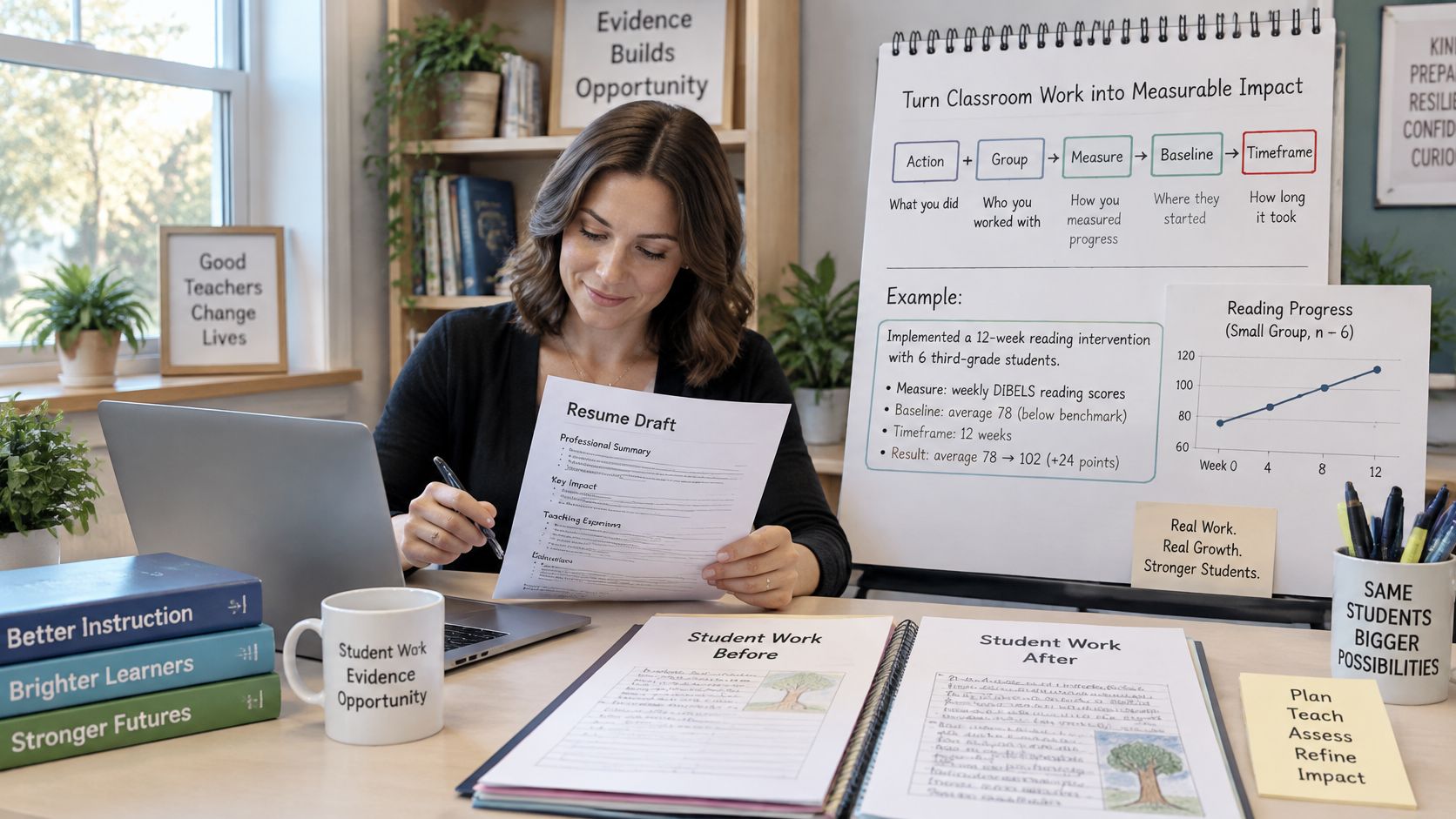
Taught reading to struggling students describes an assignment, not your instructional contribution. Rebuild it with action, group, measure, baseline, and timeframe. The University of Florida Teacher Career Toolkit recommends emphasizing accomplishments and transferable skills; classroom records help make those accomplishments defensible.
Gather your evidence before polishing the wording.
Rebuild a Vague Bullet With Context
Consider a hypothetical reading intervention: you delivered small-group instruction to 24 Grade 3 students over 12 weeks. On the same reading assessment, 18 students met the grade-level benchmark at the end, compared with 6 at the start. Those details establish the group, duration, measure, and starting point.
Don't turn that observation into a claim that your method alone caused the improvement. Students may also have received specialist support, additional instruction, or help at home. Name shared delivery when it matters.
Weak and stronger classroom impact lines
These are illustrative examples, not figures to copy into your resume.
| Weak line | Stronger line | Evidence to keep |
|---|---|---|
| Taught reading to struggling students | Delivered a hypothetical 12-week small-group reading intervention for 24 Grade 3 students; 18 met the grade-level benchmark on the same assessment, up from 6 at baseline | Starting and ending reading scores, group size, dates |
| Managed classroom behavior | Introduced transition routines for the class and documented fewer referrals during the intervention period than during the baseline period | Referral log with dates and baseline count |
| Communicated with parents | Held 30 family conferences a year, in English and Spanish, in this hypothetical example | Conference log with language and count |
Use Documented Outputs When Scores Aren't Available
Comparable test scores aren't the only evidence. Attendance records, assignment completion, referral counts, family contact logs, and dated student-work portfolios can support a precise description. Include class size or caseload when it helps explain the scope, but don't confuse workload with impact.
If assessments changed between schools, avoid presenting their scores as directly comparable. Describe the evidence separately, or focus on a documented instructional output such as creating differentiated assessment tasks. Keep student-identifying information out of your application and use only records you're authorized to retain.
A teaching credential establishes qualification. An impact line explains what you did in the room.
For a drafting prompt, use the resume bullet point generator, then verify every suggested detail against your records. Reject any invented baseline, percentage, or result.
For another resume-writing reference, use the video below.
Apply this rule to every bullet: include an action, an outcome or documented output, and enough context to make it believable. If you can't explain the measure in an interview, revise the claim.
Tailoring Your Resume to Each Teaching Job and Screen
Match the posting's language where it accurately describes your qualifications. Don't copy its entire responsibilities list. A principal needs evidence of fit, not a rewritten advertisement.
For the 2024–25 school year, U.S. public schools reported an average of 6 teaching vacancies and had filled 79% of those positions before classes began, according to the National Center for Education Statistics. Prepare your materials early enough to respond promptly, but don't mistake vacancies for relaxed eligibility requirements.
Resumes made for the job got about twice as many interviews in a 2025 Huntr study of 1.39 million applications. That's a reason to tailor deliberately, not a promise about your individual application.
Match the Vacancy Without Rewriting Your History
Use the posting's exact job title and grade band in your target summary when they fit. Keep the official title for previous employment, adding a plain-language clarification if necessary. You can target a classroom teacher vacancy without renaming a past teaching assistant role.
Follow a short matching process:
- Identify requirements: Separate required credentials from preferred experience and routine responsibilities.
- Select supporting evidence: Move the most relevant teaching bullets higher within each role.
- Use supported terminology: Include special education, ESL, or co-teaching only where your work supports those descriptions.
- Maintain focused versions: Keep separate drafts for distinct subjects or grade bands, then adapt each to the vacancy.
The guide to tailoring your resume can help organize that comparison. The useful result is a clearer match between each requirement and evidence you already have.
Handle Nonstandard Pathways Precisely
For substitute teaching, distinguish daily coverage from a long-term assignment with planning and assessment responsibilities. For special education, identify your actual instructional or case-management duties rather than treating all student support as equivalent.
For a provisional or alternative pathway, name the authorization currently held and its scope. If a license application is pending, say application submitted or under review only when that is its actual stage. Internationally trained applicants should distinguish an overseas credential from any local recognition still being assessed.
Career changers should connect subject expertise, training delivery, or youth work to the vacancy without calling unrelated employment teaching. Put detailed disclosures, references, and requested attestations in the district form, and keep dates and credential status consistent across both documents.
Your public profile should support the same professional identity. The educator branding advice from RedactAI provides context for aligning an educator profile with an application.
Before submitting, read the posting once and mark every requirement you can prove with a specific resume line.
Mistakes That Get Teacher Resumes Skipped
The most damaging opening is a generic objective that leaves the reader unsure what you teach. Seeking a rewarding position in a supportive organization could introduce almost any applicant. Replace it with information that helps the school assess your fit.
Common teacher resume mistakes and fixes
| Mistake | Why it hurts | Fix |
|---|---|---|
| Generic objective | Could describe any job | Replace with grade band, subject and certificate |
| Duties without outcomes | Shows presence, not effect | Add a result with baseline and timeframe |
| Vague license status | Screeners cannot confirm eligibility | Name the state, license type and expiry or pending status |
| Overstuffed keywords | Reads as stuffing, not experience | Use posting terms only where your experience supports them |
| Multi-page academic CV for one vacancy | Slows screening | Aim for one page unless the posting asks for more or substantial relevant experience warrants additional space |
Cut Repetition Before Cutting Evidence
A duties-only resume makes different applicants sound interchangeable. Keep necessary responsibilities where they establish scope, but rewrite the bullets that should demonstrate judgment. Planned lessons becomes more useful when it explains what you adapted, why you adapted it, and what you documented afterward.
Vague credential language creates a different problem. Certified soon asks the reader to infer a status that may determine eligibility. Keyword lists create similar uncertainty when terms such as intervention and differentiation appear without examples of actual practice.
Editing priority: Remove unsupported claims before removing the context that makes a supported claim credible.
Treat length as an editorial decision, not proof of experience. A concise resume is a sensible starting point for a focused vacancy; an extensive teaching history may justify more space. An academic CV or portfolio serves a different purpose and should follow the posting's instructions.
If a bullet is relevant but vague, rewrite it. If it duplicates another point or has no bearing on classroom work, cut it. Don't squeeze an unfocused document into a page with cramped text.
If time is short tonight, fix the opening identification, clarify your license status, and replace your weakest duty statement with defensible evidence. Those changes matter more than a new color scheme.
Check Your Resume and Send It This Week
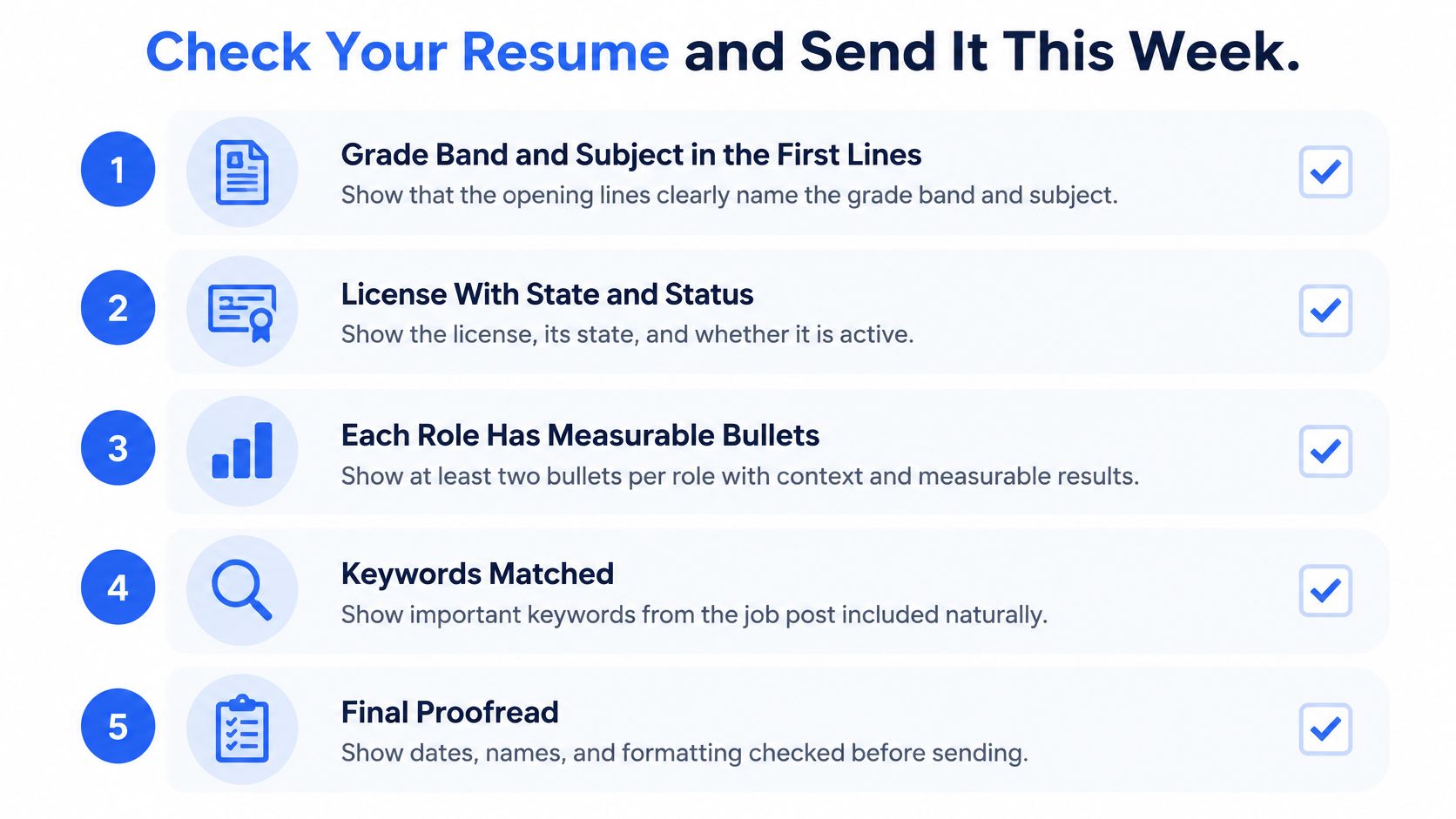
- Confirm the opening: Grade band and subject appear in the first lines, with no ambiguity about the role you're targeting.
- Verify the credential: The license name, issuing state, and current status match your official record and application answers.
- Audit each role: Aim for at least two evidence-based bullets with measurable context or documented outputs. Don't invent results to meet a quota.
- Check keyword support: Every important posting term connects to something you can explain and substantiate.
- Place transferable experience clearly: Career changers should put relevant work under an accurate role heading, not hide it in a general skills list.
- Proofread the details: Check school names, employment dates, tense, spelling, and consistent formatting.
- Prepare the file: Include your name and target role in the filename. Save as PDF unless the posting requests Word or another format.
- Keep the submitted version: Save the resume you submitted with the posting so you can prepare consistent interview examples.
Use this visual checklist for the final review.
Our resume template includes tips for career changers, and our free resume grader is available to check a resume before applying. Use feedback to prioritize revisions, then personally verify every credential, date, and classroom claim.
This week, choose one posting, tailor your master resume to it, complete the checklist, and send the application.
Capstone Workforce offers job-specific resume preparation using what you really did, along with spoken interview practice aligned with a job description. Visit Capstone Workforce to prepare your teaching application and rehearse explaining the classroom evidence behind it.