How to Put Internship in Resume: Format and Examples
Capstone · November 19, 2026
Learn how to put internship in resume with the right section, dated entry format, results-focused bullets and labels for unpaid or short placements.
You've opened your resume, added your internship title, and stalled at the bullets. The work felt useful, but now you're deciding whether answering customer questions counts as experience, whether an unpaid placement belongs beside a paid job, and how to describe a team project without claiming everyone else's results. Putting an internship on your resume starts with an accurate label, then a clear account of what you personally contributed.
Table of Contents
- Where an Internship Belongs on Your Resume
- Format Each Internship Entry Line by Line
- Label Unpaid, Short or Nonstandard Internships
- How to Write Bullets With Measurable Results
- Tailor Internship Bullets to Each Job Posting
- Confirm Your Internship Entry Before You Apply
Where an Internship Belongs on Your Resume
Decide where the internship sits before you polish a single bullet. Placement is a truthfulness decision as much as a formatting one: where you file the work signals how much weight you are claiming for it, and a recruiter reads that signal before reading a word of the bullets. The title, employer, and dates should be findable in seconds. The bullets then carry the proof of what you handled, whether that meant users supported, applications processed, reports produced, or research completed.
Four rules cover most situations:
- Default to Experience. List internships in reverse chronological order alongside other work. Paid or unpaid, the placement counts the same way.
- Prioritize relevant work carefully. An older internship can sit above unrelated employment in a clearly labeled Relevant Experience section. Keep the date order intact inside a chronological section.
- Separate substantial internship experience. Use an Internship Experience heading when you hold several placements or when they outweigh your other work.
- Put the stronger section first. Place Internship Experience above other employment only when it offers better evidence for the target role.
Give the experience appropriate weight
Internships carry real evidence of employability. In the Class of 2015 survey by the National Association of Colleges and Employers, students who completed paid internships or co-ops at private, for-profit companies received full-time offers at 72.2%, compared with 43.9% for unpaid interns. One graduating class in one job market makes that context, so read it as evidence that internships convert, with paid placements converting better.
Placement rule: Relevance decides the position. An internship that matches the target role earns its place in your primary section, whatever its employment status was.
If your resume still reads like a transcript, this college resume guide shows how to balance coursework against experience. The same space discipline applies to optional elements. Before giving a photograph room on the page, browse AiHeadshots resume advice, because every line a photo occupies is a line your experience could have used.
Format Each Internship Entry Line by Line
| Element | What to write | Example |
|---|---|---|
| Job title | Formal title from the offer letter or posting | Marketing Intern |
| Employer | Organization name, plus division if it matters | Harlow Health Group, Patient Outreach |
| Location | City and state, or Remote | Columbus, OH |
| Dates | Month and year with an en dash; use Present if ongoing | May 2024–August 2024 or May 2024–Present |
| Bullets | Three to five achievement lines starting with action verbs | Analyzed survey responses in Excel and flagged data-entry errors |
Treat this as a guide to entry components, not a table to paste into your resume. The following fictional example shows how those components fit together. The organization and duties are illustrative, not claims to copy into your own history.
Marketing Intern
Harlow Health Group, Patient Outreach | Columbus, OH
May 2024–August 2024
- Analyzed patient outreach survey responses in Excel and flagged inconsistent entries before campaign reporting.
- Collaborated with outreach staff and designers to revise patient-facing email copy for clarity.
- Prepared campaign summaries that helped the outreach manager compare audience responses.
The bold verbs are for demonstration. On your finished resume, ordinary bullet text is fine.
Make the header easy to interpret
Use the formal title unless it would materially misrepresent the arrangement. Include the division when it explains your work, but don't crowd the employer line with an internal reporting hierarchy. For a current placement, use an open-ended date such as May 2024–Present, and keep the same date style throughout the document.
For remote work, Remote describes the work location. It doesn't replace the employer's name or explain your responsibilities. If you're pursuing another remote position, LatoJobs' remote job search tips can support the broader search while your entry demonstrates the actual work.
Show collaboration through a task
NACE's candidate-selection guidance reports that 85% of employers look for teamwork skills on a resume. That supports including a concrete collaboration bullet rather than adding team player to a skills list.
Name whom you worked with and what you produced together. Collaborated with designers to revise patient-facing copy gives a recruiter something to ask about; worked well with others doesn't.
Keep only bullets that add distinct evidence. A complete-looking entry isn't stronger if its final lines repeat the first.
Label Unpaid, Short or Nonstandard Internships
Changing Marketing Intern to Marketing Manager doesn't make a placement more impressive. It creates a claim about authority that your interview answers, references, or employment records may not support. The label should explain the arrangement, not disguise it.
Indeed's internship resume guidance supports presenting internship experience with recognizable titles, organizations, dates, and accomplishments. For less conventional placements, add enough context to make the relationship understandable.
| Situation | How to label it | Example line |
|---|---|---|
| Unpaid internship | Same layout as paid roles, with the formal title | Research Intern, Community Health Lab |
| Placement under six weeks | Keep exact dates and lead with the finished deliverable | Summer Intern, June 2025, three weeks |
| Remote project | Name the scope of the work in the title | Remote Research Project, Student Consultant |
| University, nonprofit or accelerator placement | Name the sponsor as the employer | Student Consultant, Venture Lab at State University |
| Family business | Name the business as the employer and keep a true intern title | Operations Intern, Alvarez Hardware |
| Title larger than the duties | Use the arrangement title that matches the work | Marketing Assistant Intern, not Marketing Manager |
The names and dates in this table are hypothetical formatting examples. A brief placement doesn't need an invented minimum duration to qualify as experience; it needs meaningful work you can explain.
Resolve ambiguity rather than hiding it
An unpaid internship doesn't require a pay line. Describe its professional substance using the same layout you'd use for paid work.
For a short placement, retain accurate dates and lead with the finished deliverable. Don't use a broad seasonal label to imply months of work when you attended briefly.
For sponsored projects, distinguish the sponsor from the beneficiary. If a university lab arranged a consulting project for an outside organization, identify the lab as the sponsor and describe the client relationship in the bullet. Don't imply the client directly employed you.
A family-business placement should name the business and describe actual responsibilities. You don't need to turn the entry into a family history, but you shouldn't imply an independent hiring process if asked.
A credible label tells the recruiter what level you worked at and under whose supervision.
If an issued title exaggerates your duties, retain it with a clarifying internship descriptor or use an accurate functional label. Be prepared to explain the difference from the original paperwork.
How to Write Bullets With Measurable Results
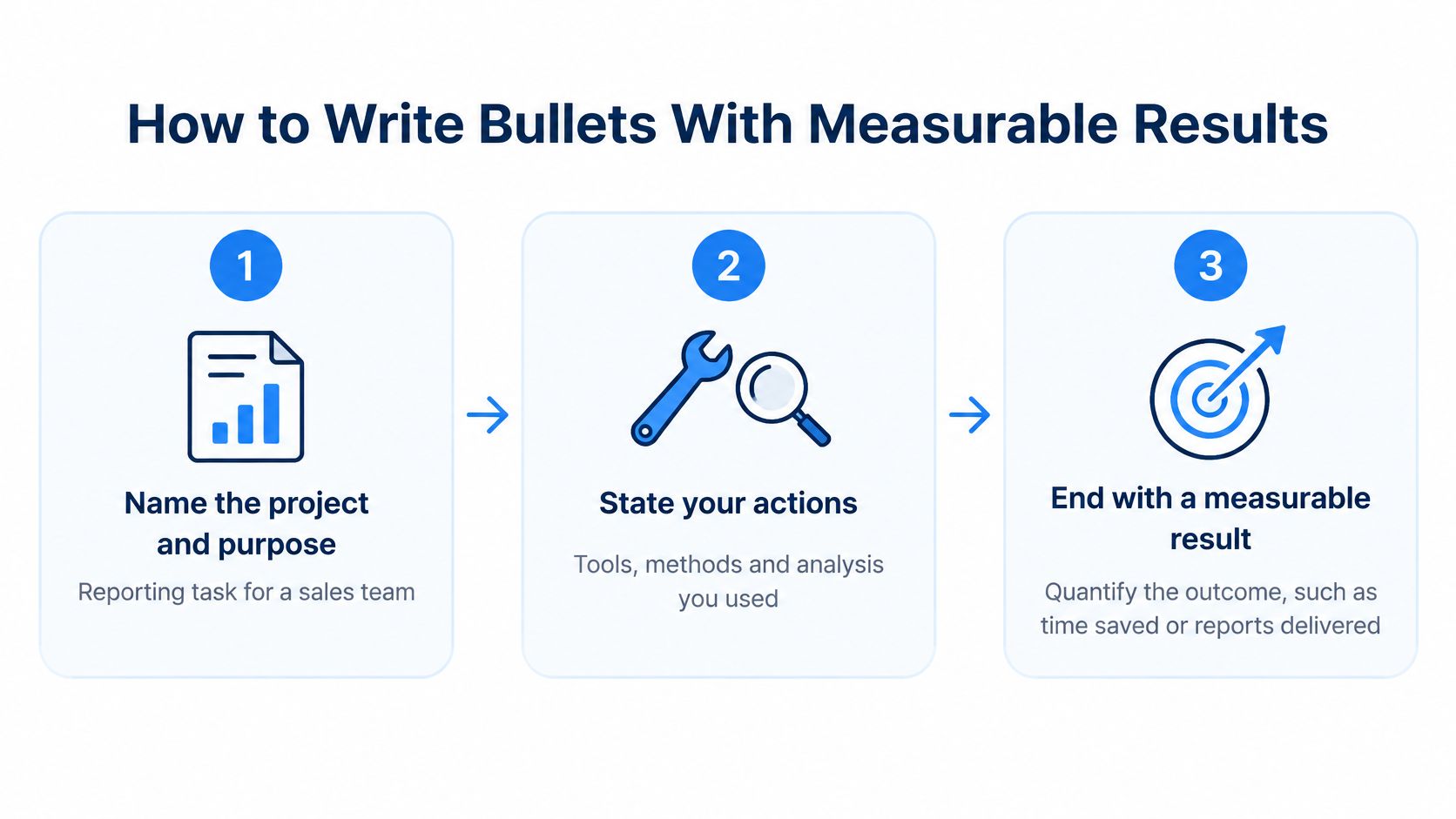
A useful bullet explains the assignment, your intervention, and what came out of it. Project–Action–Result, or PAR, gives you a way to build that evidence without inflating routine work.
Use this process to separate the work's purpose from your own contribution.
Build the bullet from the underlying work
Name the project and purpose. Start by identifying what the assignment was meant to support. Before: Helped with reporting. After: Prepared customer-data summaries for the sales team's monthly reporting. The revised version establishes a specific object and audience without claiming an improvement you haven't demonstrated.
Describe your personal actions. Add the method, tool, or decision that makes your contribution visible. Before: Worked on customer data. After: Cleaned duplicate customer entries in Python and checked the revised dataset before reporting. Don't list software just because colleagues used it. Include tools you operated yourself.
Finish with a verifiable result. Connect the work to a measured outcome or defensible scale. A numerical example consistent with Harvard's fact-based resume guidance and PAR approach is: Analyzed 2,400 customer records in Python, cleaned duplicate entries, and reduced monthly reporting time by 30%. Those are illustrative figures, not suggested targets or numbers to borrow.
The result should follow logically from the action. Cleaning duplicates might reduce reconciliation work, but it doesn't automatically mean you increased revenue. If you can't explain the connection, narrow the claim.
Improve a vague social media bullet
Before: Helped with social media.
After, when records support it: Created Instagram posts for the outreach campaign and summarized changes in engagement for the marketing lead.
To make that bullet measurable, replace the general wording with your documented post count and engagement change. Use the platform's actual metric name, such as engagement rate or total interactions, rather than treating every increase as the same outcome.
If you didn't measure engagement, stop at the deliverable and its scope. A truthful content-production bullet is better than an unsupported performance claim.
Attribution check: Contributed to a team outcome isn't the same as caused it. State your deliverable first, then describe the broader result only when you can support the connection.
No formal KPI? Use records processed, stakeholders supported, presentations delivered, experiments completed, or deadlines met. Check your task tracker, approved reports, calendar, and supervisor feedback without copying confidential material into your resume.
Choose verbs that match your authority using this resume action verb guide. Technical applicants can also compare junior and senior engineer resumes from Underdog.io to see how scope differs by level, rather than borrowing senior ownership language.
For another explanation of resume presentation, use the video below.
Finish by checking each bullet for a strong verb, specific object, and result or scale indicator. If a sentence only describes what the department does, it still needs your contribution.
Tailor Internship Bullets to Each Job Posting
Tailoring means changing which truthful evidence you emphasize. It doesn't mean rewriting your history to match every requirement.
Start with the posting's repeated tools, methods, credentials, and deliverables. Separate required experience from preferences, then match each relevant term to something you did.
Use the posting beside your resume so you can compare requirements with evidence.

Translate the capability without changing the task
Consider a factual master bullet:
Master version: Cleaned survey data in Excel, flagged incomplete responses, and prepared a summary for the project lead.
That contains distinct layers:
- Original task: Cleaning survey data in Excel.
- Transferable capability: Data validation, checking completeness, and summarizing findings.
- Employer vocabulary: Quality assurance for an operations role, or data preparation and reporting for an analyst role.
For an operations application, you might write: Checked survey records in Excel for completeness and flagged exceptions for project-lead review.
For an analyst application, you might write: Prepared survey data in Excel for analysis and summarized incomplete-response patterns for the project lead.
Both versions preserve the same work. Neither upgrades Excel work into SQL experience or basic checking into statistical modeling.
Indeed's guide to internships emphasizes the practical experience and skills candidates can draw from placements. Keep coursework-based skills under coursework or projects when you didn't use them during the internship. A keyword's location should tell the truth about where you learned and applied it.
Make relevant evidence readable
Use a standard Experience heading, straightforward typography, and consistent dates. Avoid putting essential details inside text boxes, graphics, or headers, and don't turn your resume into the comparison tables used in this article.
For a repeatable application process, use this guide to tailoring your resume. Maintain a factual master with your full set of supported accomplishments, then select and reorder evidence for each role.
The final comparison is simple: underline each job-related term in your entry and identify the task behind it. If you can't produce that example, remove the term or place it under the experience that supports it.
Confirm Your Internship Entry Before You Apply
Treat the finished entry as a send-or-revise decision, not an invitation to keep polishing indefinitely. A clear, defensible entry is ready when its claims and presentation survive these checks.
Run the release check
- Preserve the master. Save your factual version under a stable filename, then create an employer-specific copy. Confirm that tailoring hasn't changed the underlying accomplishments.
- Check tense and status. Use past tense for completed work and present tense for ongoing responsibilities. A current internship needs an open-ended date, not a guessed completion date.
- Test your explanation aloud. Mark any tool, metric, or team result you couldn't explain in an interview. Replace unsupported impact claims with verifiable outputs.
- Audit the relationship label. Check that a short, remote, sponsored, unpaid, or family-business placement doesn't imply a different arrangement.
- Inspect continuity and duplication. Remove repeated bullets and prepare a brief, factual explanation for a date gap. You don't need to disclose private circumstances on the resume.
- Release the correct copy. Reopen the file you intend to submit and confirm the employer, title, and content match that application.
Use this checklist as your final submission reminder.
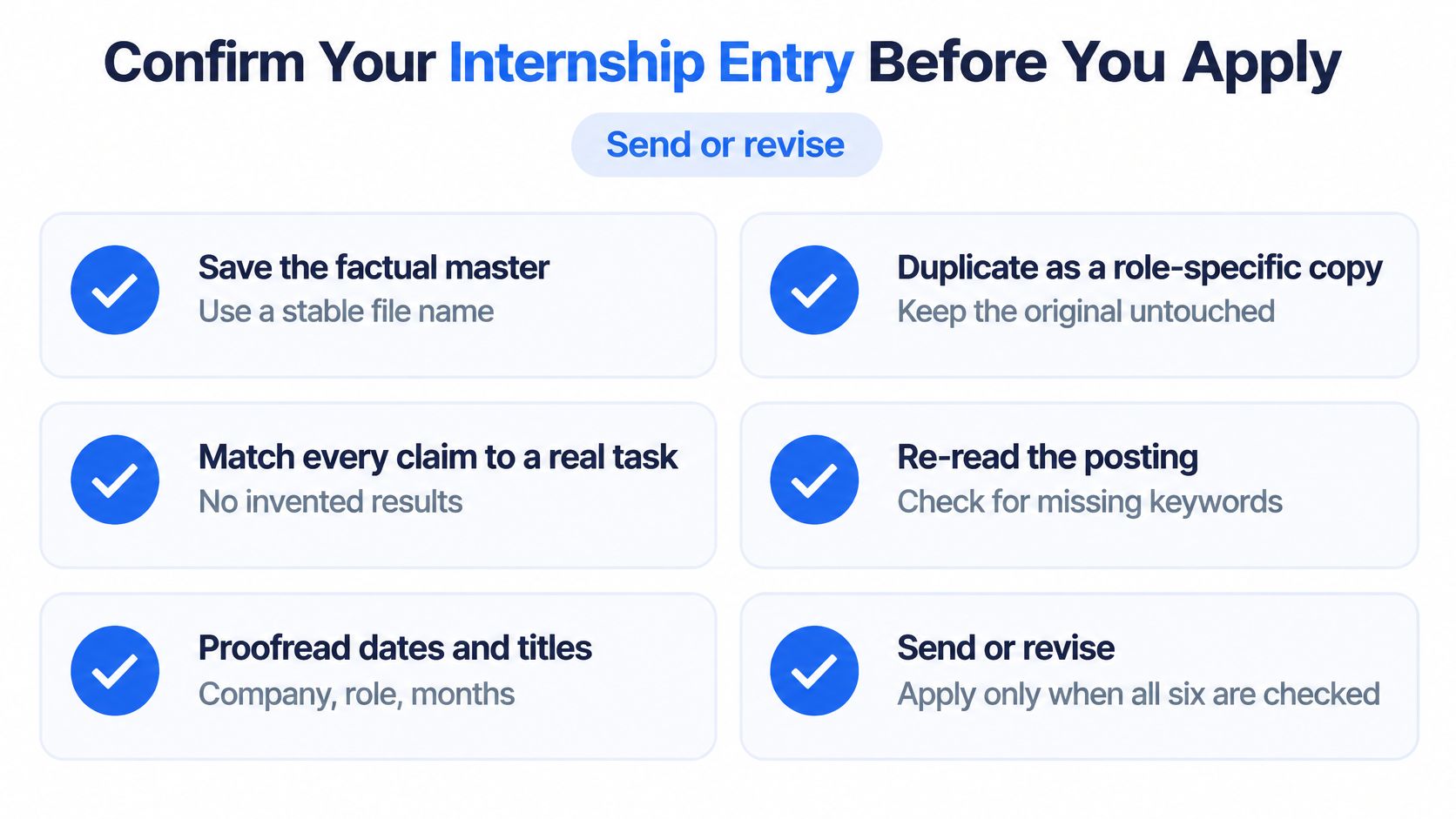
Send or revise: If every check passes, apply with the role-specific copy and leave the master untouched. If a claim or label fails, fix it before submitting.
Our Capstone Applied tool writes a resume for each job using only what you really did, including internship experience that supports the role. Visit Capstone Workforce to use our free resume grader before applying or prepare a job-specific resume grounded in your actual contributions.