How to Prepare for a Second Interview: Steps That Work
Capstone · November 21, 2026
How to prepare for a second interview: research the role, practice with scored evidence, repair weak answers and follow up within 24 hours.
The recruiter's message says they'd like you to come back, and it lists two names you don't recognize plus a note about a short case discussion. The first round felt manageable because you'd rehearsed the obvious questions. This one is harder to picture, and most advice stops at "go deeper" without saying what that means. A second interview isn't a repeat of the first, it's an evidence check run by different people against a narrower set of questions. What follows is how I'd prepare for it, in the order I'd do the work.
Table of Contents
- Research the Company, Panel and Role
- Map the Job to the Skills They Will Test
- Build Your Prep Cycle and Score Mock Rounds
- Repair Weak First-Round Answers Without Sounding Defensive
- Check Logistics and Questions Before the Day
- Decide When and How to Follow Up
Research the Company, Panel and Role
Three sources of information are worth an hour before you open a single practice question. Candidates who skip straight to rehearsing answers often find themselves in the room prepared for a company that no longer exists in its current form.
The company. Read the current product or service pages, the leadership page, and any public announcement from the last six months. You're looking for one priority that touches the role you applied for. A retailer rolling out a new fulfilment system, a clinic opening a second site, a software team retiring a legacy product: each creates a problem the person they hire will be asked to solve first.
The team. The job posting tells you which function the role sits in and what that group owns. Your first-interview notes tell you what the interviewer cared about, so reread them and pull out every name, title and topic that came up. A hiring manager who spent four minutes on reporting accuracy has told you what round two will test.
The panel. Ask the recruiter to confirm who you're meeting and what each person's title is. Then review their public professional profiles and work out which part of the role each one owns. A peer will probe how you operate day to day, a manager will probe judgement and priorities, and a skip-level will probe whether you understand the business rather than just the job.
Turn the Findings Into Three Questions
Write three lines, each one a question the second round will probably probe: how the team measures success, which problem the role must solve first, what changed in the last year that created the opening. Attach a source and a date to every line and delete anything you can't verify. A guess you can't defend is worse than a gap you can name out loud.
Keep that list visible for the rest of your preparation, because every example you choose afterwards should answer one of those three questions. Research that doesn't change what you say is just reading.
Map the Job to the Skills They Will Test
The people you meet in round two already believe you can probably do the job. What they're testing is whether the stories you told hold up when someone leans on them.
That pressure is deliberate. Employers run structured second rounds, standardized questions with scoring rules tied to a job analysis, because that format predicts on-the-job performance better than an unstructured conversation and gives every candidate the same examination. Your job is to work out which capabilities the structure was built to measure.
Name three to five. Five rows is the right size for most roles; more than that and you end up with shallow evidence for all of them.
| Capability | What interviewers probe | Evidence to prepare |
|---|---|---|
| Problem-solving | How you break down an unfamiliar problem | One decision with the trade-offs you weighed |
| Customer judgment | How you handle competing customer needs | One case where you chose the long-term relationship over the quick fix |
| Technical knowledge | How deep you go on the core tools in the role | A project where you explain a method and its limits |
| Teamwork | How you work with peers who disagree | A disagreement you resolved, with the measurable outcome |
| Leadership | How you influence without formal authority | A decision you moved or a team you aligned, with the outcome |
Then map each row to the posting's own language, which is where candidates go wrong. A logistics coordinator applying for a second role may assume the round will test organization, because the posting says "highly organized." The actual question is usually about the shipment that arrived late and broke a customer contract: what you saw, when you told the customer, what you traded off to protect the relationship. The capability on trial is judgement under constraint, and "I'm very organized" answers a question nobody asked.
Expect the same capability from two angles. Second rounds add interviewers, so a peer asks how you handled the account manager who kept changing requirements, and the manager asks what you'd change about the escalation process. Same story, different evidence. Prepare one version that shows what you did and a second that shows what you learned from it.
Before you close the document, mark the two capabilities the first interview barely touched. Those gaps are what round two exists to fill, and they're where the sharpest questions will land. If you want to see how those prompts are usually phrased, this collection of scenario questions for interview shows the common shapes.
Build Your Prep Cycle and Score Mock Rounds
Rehearsing generic questions feels productive and changes very little. What moves your performance is a repeatable cycle where you score yourself against the same standard every time.
Here's the structure I'd use, with the reason each step earns its place.
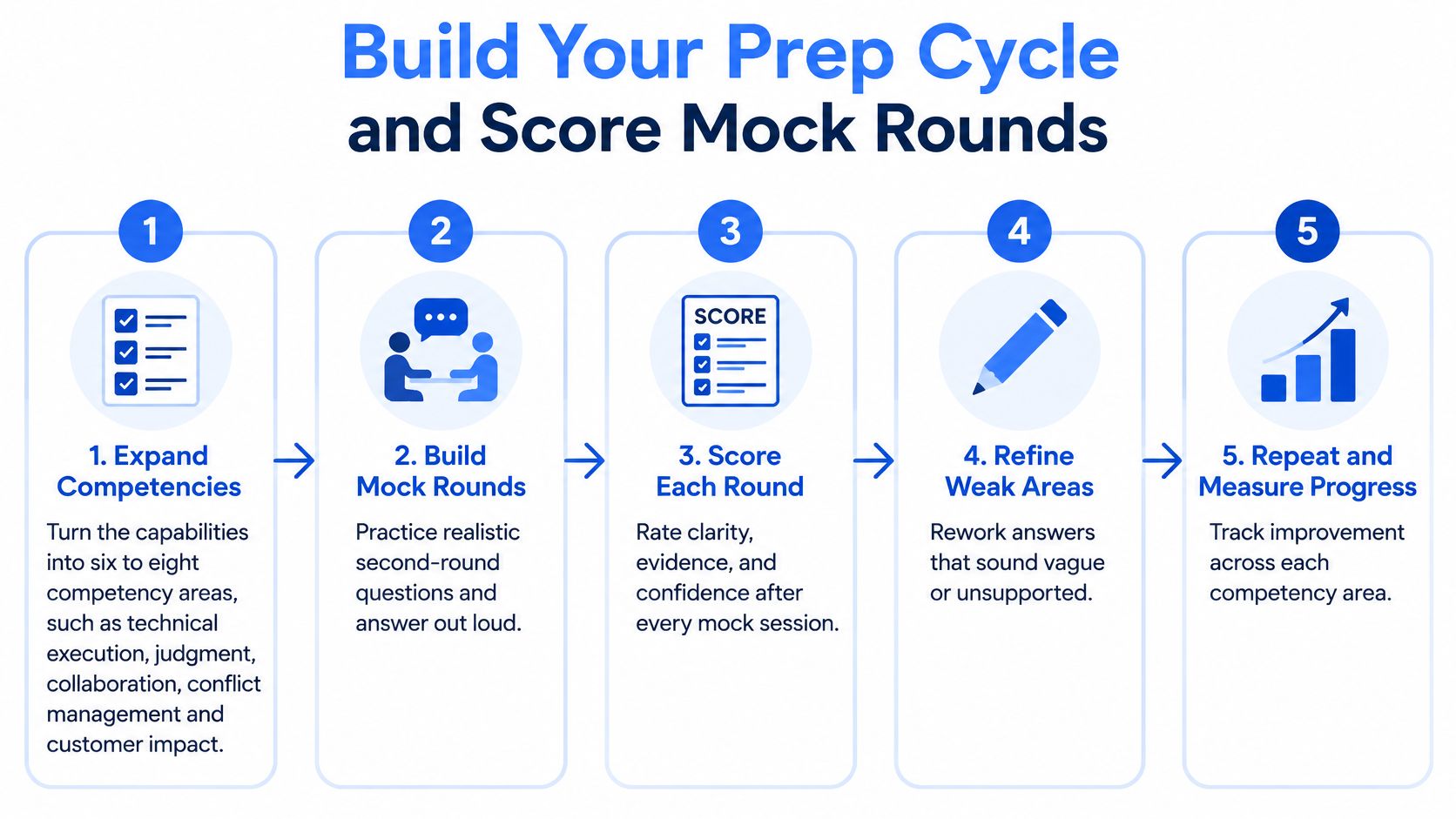
Step 1. Expand your five capabilities into six to eight competency areas. Technical execution, judgement, collaboration, conflict management, customer impact. Do this because job postings use the employer's vocabulary and interviewers use their own, so you need a bridge between the two.
Step 2. Build a question matrix with at least two prompts per competency. Two, not one, because round two almost always approaches the same capability from a second direction and a single memorized story collapses under the follow-up.
Step 3. Prepare eight to ten STAR examples, each with a measurable result. Time saved, revenue protected, defects reduced, a customer outcome, a delivery improvement. Keep each spoken answer to two or three minutes, then rehearse aloud under time pressure. The pitfall here is inventing metrics to make a story land. If the exact figures are confidential, use defensible ranges, percentages, a baseline, or a clearly labeled estimate. "Roughly 40% fewer tickets, and that's an estimate from the monthly report" survives a follow-up. A fabricated precise number doesn't.
Step 4. Run each mock with the same questions and the same rubric. Score every answer from 1 to 5 on evidence quality, relevance, structure, concision and role fit. Record yourself so you can hear answer length, filler words and the point where you lost the thread. Then have a reviewer score the recording against the same rubric rather than telling you it "sounded good."
| Criterion | A score of 5 looks like | A score of 2 looks like |
|---|---|---|
| Evidence quality | Named metric with a baseline and a result | Vague claim such as "I improved things" |
| Relevance | Answer addresses the need stated in the job posting | Story answers a different question |
| Structure | Situation, action and result in order, under three minutes | Chronology with the result missing |
| Concision | Key point in the first 20 seconds | Two minutes of background before the action |
| Role fit | Names a decision the target role actually makes | Generic claim that would fit any job |
Step 5. Revise only the lowest-scoring element, then repeat with new prompts. Convert every criticism into an observable behavior: "state the decision criterion within 20 seconds" rather than "be more confident." New prompts each round test transfer instead of memorization. Stop when your weakest criterion reaches a 4 on your three most likely questions, then leave it alone.
If the role is technical, the same discipline applies to thinking out loud under observation, and reasoning patterns for coding interviews from PracHub is a solid reference for structuring a solution while someone watches.
The reason this cycle beats casual practice is the same reason structured interviews beat unstructured chats. A major re-analysis reported operational validity of roughly .42 for structured interviews versus .19 for unstructured ones, according to Pulsifi's comparison of the two formats. Consistency is the mechanism in both directions. Job seekers use Capstone Workforce to rehearse interviews out loud, which is the only reliable way to catch filler words and answers that run long.
Finish with a one-page evidence sheet: your metrics, your stated assumptions, the questions you'll ask, and three role-specific examples. It's a prompt, not a script. For extra reps, our mock interview questions give you a second set of prompts to test transfer.
Repair Weak First-Round Answers Without Sounding Defensive
Halfway through the second round, an interviewer says: "You mentioned the team cut onboarding time. What did you personally change?" Your first-round answer credited the team. Now you're being asked to separate your contribution from everyone else's, on the spot, without sounding like you're inflating or backtracking.
This is the moment most preparation guides skip. They tell you to review the first interview and prepare more detailed examples. They rarely tell you how to repair an answer mid-conversation when a follow-up exposes that your first version was thin, vague, or overstated.
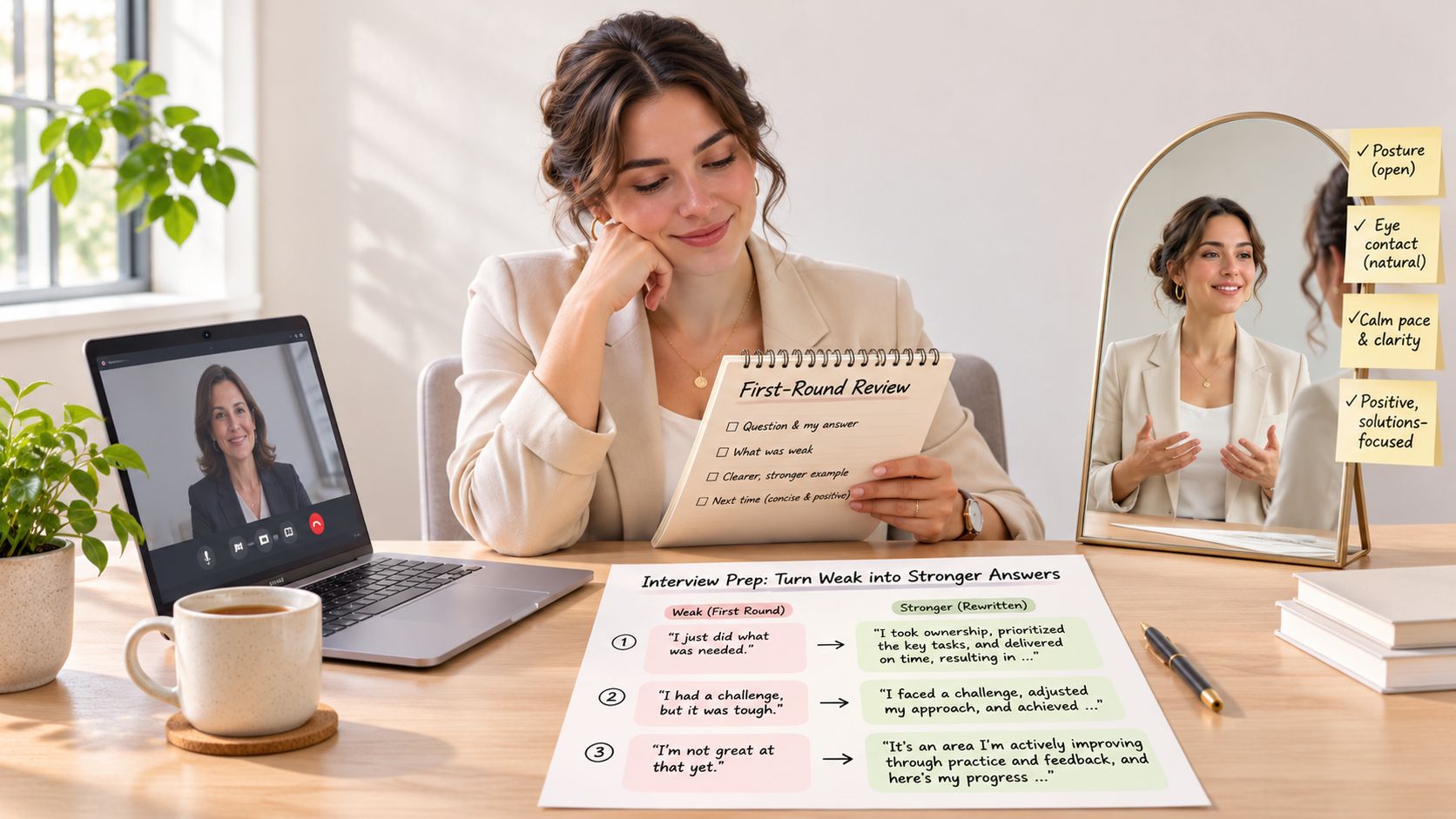
Start by naming your three most likely weak points before the interview: an overstated role, a missing constraint, and a result that didn't land. Then rehearse these three sentences until they're automatic.
Repair lines worth having ready: "Let me clarify my role in that project." "I left out an important constraint." "The result was mixed, and here is what I learned."
What makes them work is specificity, not humility. "I owned the vendor selection and the migration checklist. Two engineers on the team delivered the launch in June, and my part was the six weeks before it." That's not defensiveness, it's precision.
Correct the record when a claim you made was inaccurate. Acknowledge uncertainty when you don't know a figure, and say what you'd check to find it. Those are two different moves, and confusing them is what makes candidates sound evasive.
This matters more than it used to because some interview systems now generate adaptive follow-ups rather than reading fixed questions. One preliminary evaluation described in Amazon's account of structured AI interviews found assessments based only on a candidate's initial response scored up to 1.14 points lower on a five-point scale than assessments based on the full conversation. A prepared repair is worth more than another polished story.
Check Logistics and Questions Before the Day
Strong candidates get sunk by a muted microphone, a case prompt they didn't know was coming, or a work sample they can't share because the screen-sharing permission wasn't set. Walk through this list the day before, not the morning of.
Confirm the format first. Panel, presentation, case exercise or take-home sample, and how long each part runs. Ask the recruiter directly. The format changes what you prepare, so it's the first question worth asking.
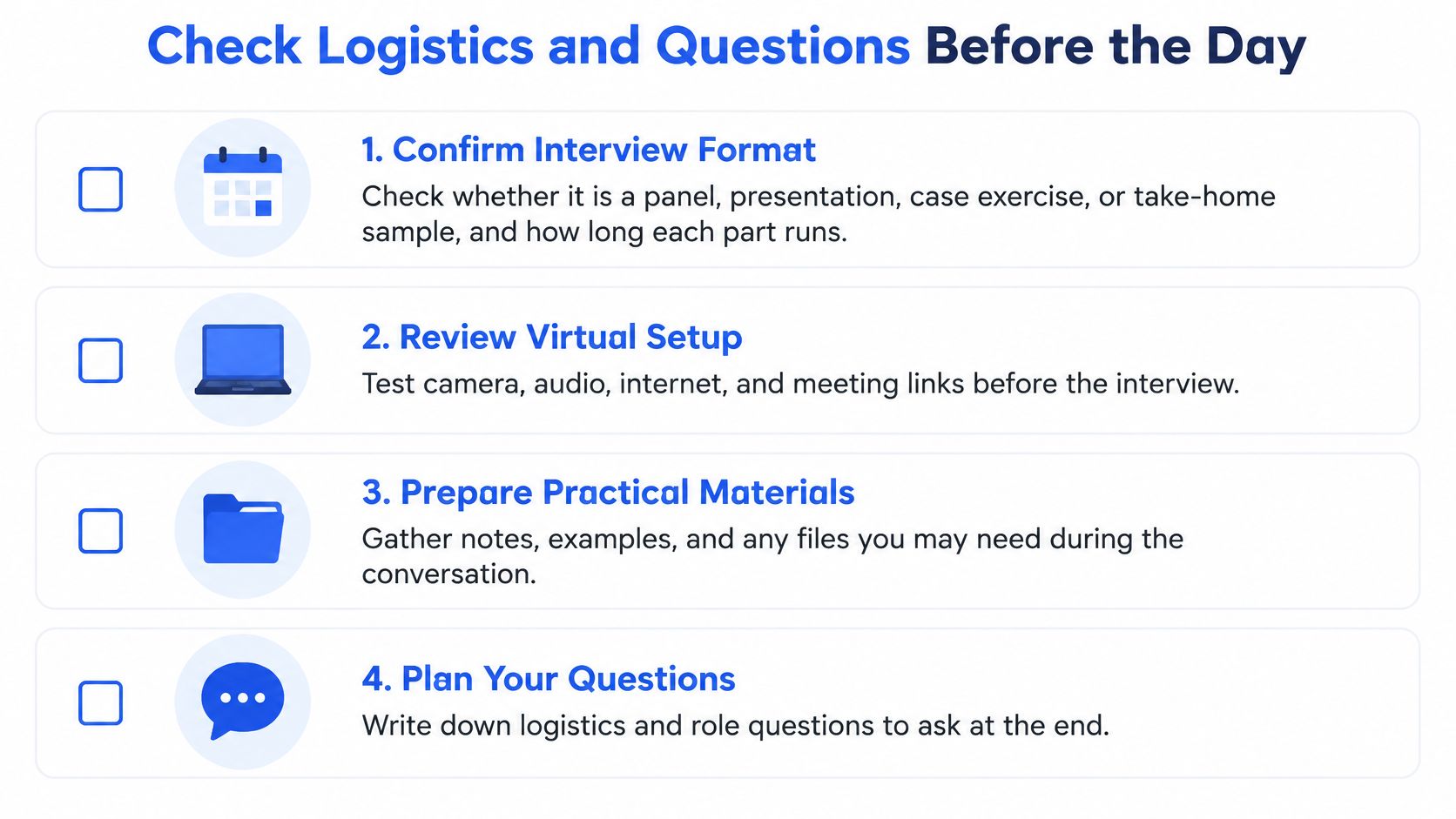
Test the virtual setup. Microphone intelligibility, camera framing with your face in the upper third of the frame, screen-sharing permissions granted in advance, and a backup connection such as a phone hotspot. Open the work sample on a second window before the call so you're not hunting for a file while three people watch.
Dress for the panel, not the mirror. On video, the collar and shoulder line carry most of the impression, and a jacket that pulls across the chest reads as discomfort on camera. If you're unsure how a shirt or blazer is meant to sit, this guide to signs your clothes fit wrong is a fast check worth doing before the day.
Prepare three questions that show you've thought about the role. What success looks like at 90 days, how the team handled its last major change, and what the biggest open problem is right now. Bring the one-page evidence sheet and use it as a prompt, not a script. Confirm the names and titles of everyone on the panel too, so the follow-up you send afterwards is personal.
One full rehearsal of the logistics, camera angle, screen share, opening two minutes, is the step most candidates skip. It takes fifteen minutes and it's the cheapest insurance in the whole process.
Decide When and How to Follow Up
Send a short, personalized thank-you email within 24 hours. That's the rule, and everything else is a timing decision.
A 2017 Accountemps survey of more than 300 U.S. human-resources managers found that 22% considered a thank-you message very helpful in a hiring decision and 58% considered it somewhat helpful, while only 8% said it was not helpful at all, as reported in this guide to thank-you emails after an interview. The same survey found that 94% of HR managers viewed email as an appropriate method and 86% also accepted a handwritten note. These are employer opinions, not controlled results, so treat the message as a low-cost confirmation of fit rather than a substitute for how you performed.

The email itself has four parts: the interviewer's name, one substantive topic from the conversation, a relevant accomplishment connected to that topic, and a restated interest in the role. If several people interviewed you, write to each one separately. A group note reads as a broadcast.
| Situation | When to send | What to include |
|---|---|---|
| Employer gave a decision date | Thank-you within 24 hours; check in only after that date passes | Thank-you now, one check-in later |
| No decision date given | Thank-you within 24 hours, then one polite follow-up after about a week | Thank-you plus one topic from the interview |
| Several interviewers | Within 24 hours, one message per person | A personal point for each interviewer |
| You gave a weak answer | Within 24 hours | One clarification of that specific answer, kept to two sentences |
Two things not to do. Don't introduce a new long argument or re-send your résumé. Don't clarify an answer unless it was unclear, and if you do, hold it to two sentences.
Draft the email before the interview and save it as a draft. The candidates who send something thoughtful at 9 p.m. after a three-hour panel are the ones who wrote it in advance. Our follow-up after interview walkthrough covers tone and structure if you want a model to adapt.
Here's a short walkthrough of the timing and tone if you'd rather hear it than read it.
One boundary worth stating plainly: preparation improves how you present evidence, and it doesn't control the decision. We help people prepare for an interview once they have one, and we can't place anyone in a job. The offer depends on the panel, the competition and the budget, none of which your rehearsal reaches.
What rehearsal achieves is closing the gap between a candidate who has the experience and one who can demonstrate it under questioning. Pick two capabilities the first round barely touched, write the three sentences you'd use to improve your weakest answer, and run one scored mock before the actual conversation. That's the whole method.
Capstone Workforce is built for the part of this process that happens alone, before the room. You paste the job description, answer out loud, and get scored on clarity, structure, pacing and filler words, with one specific thing to fix in each answer and the chance to try again. If you have a second round coming up, visit Capstone Workforce and run your first scored mock today.