How to Explain an Employment Gap: Sample Lines That Work
Capstone · November 17, 2026
Learn how to explain an employment gap on your resume and in interviews, with a four-step formula and sample phrasing you can adapt today.
U.S. field experiments show callback rates fall as time out of work grows, so an unexplained gap is easy for recruiters and screening software to read as risk. Treat the explanation as two jobs: make the dates parse cleanly on the resume, then give a short spoken account that moves from reason to present readiness.
Table of Contents
- Why a Clear Explanation Beats a Blank Space
- How to Build Your Gap Explanation Step by Step
- Sample Phrasing for Common Gap Reasons
- Fixing Gaps on Your Resume and Applications
- Handling Follow-Up and Personal Questions
- Practise Your Explanation Before the Next Interview
Why a Clear Explanation Beats a Blank Space
A gap gets read twice before anyone hears you explain it. Resume parsing and date scanning come first: screening software and recruiters check your timeline for continuity, and a blank stretch fails that read before a person ever weighs in. The spoken answer comes second, and it has to match whatever the written version implied. Get the first layer right, because it decides whether you reach the second one at all.
The cost of leaving that first layer blank is measurable. The U.S. field experiment summarized by J-PAL found candidates unemployed for one month received callbacks at roughly 7%, while those unemployed for eight months received callbacks at about 4%, approximately a 45% reduction. Most of that decline happened inside the first eight months. Employers react to unexplained elapsed time with extra scrutiny, and the drop measures the penalty for silence rather than your ability to do the work.
A clear explanation puts boundaries around the time. It gives the stretch a start, an end, and a neutral reason category, then returns attention to current evidence: a certificate, a recent project, volunteer work, a measurable result. Any of those does more work than a long backstory.
A good explanation doesn't erase the gap. It makes the gap finite, understandable, and less important than your present readiness.
Measure your own gap before you write anything. Under six months, six to twelve months, and longer each get different treatment. The longer the stretch, the more the resume has to say for you, and the more rehearsed the spoken answer needs to be.
Callback Rate by Time Out of Work
| Time unemployed | Callback rate |
|---|---|
| One month | roughly 7% |
| Eight months | about 4% |
| Past eight months | the rate keeps sliding, but more slowly |
Treat the pattern as a warning about silence. Every unexplained date range invites the reader to fill the blank with the least generous guess.
How to Build Your Gap Explanation Step by Step
Build the written version first, because your timeline has to make sense before anyone hears you speak. Then compress it into a spoken answer. The SHRM summary of the ResumeGo field experiment reports applicants with gaps had a 45% lower chance of receiving an interview than applicants without gaps, while applicants who supplied a reason received nearly 60% more interviews than those who did not. Additional training or education produced the highest callback rate among explanations.
That is why I recommend this exact order. It answers the recruiter's real questions without turning into a confession.
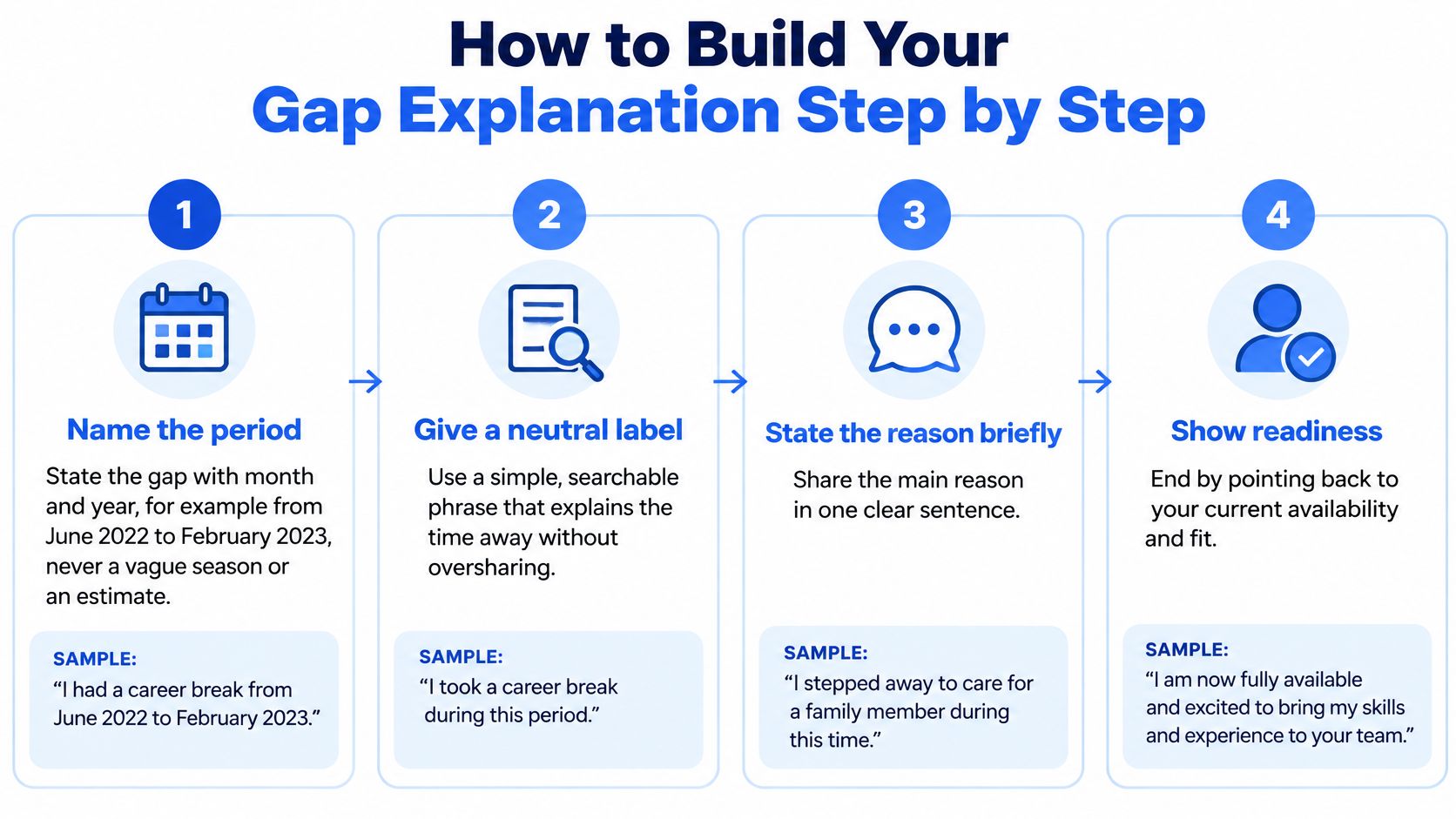
The Four Steps
Name the period. Use month and year, for example, "from June 2022 to February 2023." Don't say "a while back" or "last year sometime." Vague dates look evasive, and they create mismatches with background checks and LinkedIn. If you don't remember exact months, check old emails, pay records, or offer letters before you apply.
Give one neutral reason category. Say family caregiving, health recovery, relocation, training, layoff, or contract ended. Avoid "personal reasons" if a clearer, still private category fits. The common slip here is adding detail nobody asked for. A category is enough. You don't need a diagnosis, a relative's condition, or office politics.
Name one constructive activity with a result. Pick the strongest true item, not a list. "I completed a project-management course" is decent. "I completed a project-management course and built a tracking system for a volunteer group" is better because there's an output. If you cared for family full time, say that plainly and add any course, freelance project, or community work only if it's real. Don't invent structure you didn't have.
Connect it to this role and close on availability. End forward, not backward. For example, "That scheduling and tracking work is directly relevant to operations coordination, and I'm available to start full time." The slip is trailing off after the reason, which leaves the interviewer sitting in the gap with you. Always land on the job.
A Complete Example
"I took time away from June 2022 through February 2023 for family caregiving. I completed a project-management course and built a tracking system for a volunteer group, and I'm now ready for a full-time operations role."
That's the whole shape. Period, reason, evidence, readiness. Spoken at a normal pace, your version should run about 30 to 45 seconds. If it's longer, you're probably explaining motives, apologizing, or stacking too many activities. Cut backstory first. Keep the one activity that best matches the job description.
A few trade-offs matter. More honesty isn't the same as more detail. More activity isn't always more credible either, especially if you claim four certificates during a period you also describe as full-time caregiving. Recruiters notice inflated timelines. One believable item beats a heroic list.
If you want guided practice before you use your line live, our career re-entry practice page covers the gap conversation in depth. Use it to test whether your dates, label, and closing line sound consistent when you say them out loud.
Don't fabricate dates or imply uninterrupted employment. A short accurate answer can be defended in every round. A polished false one usually collapses on a simple follow-up.
Sample Phrasing for Common Gap Reasons
Use these lines as scaffolding, not scripts. Swap in your real dates, your real activity, and one concrete result. If a line mentions a certificate you don't have, replace it with what you did or remove that clause.
Evidence argues for modest expectations. The 2016 experimental evidence summarized by Bizwomen involved 3,771 resumes sent to 1,257 vacancies and found explained illness-related gaps received callbacks at 25.6%, compared with 23.3% for unexplained gaps. A reason helps reduce uncertainty. It doesn't guarantee you'll be treated as if no gap exists, so the activity and readiness clauses still matter.
Sample Interview Lines by Gap Reason
| Gap reason | Sample interview line |
|---|---|
| Family caregiving | I stepped away from work from March 2021 to August 2023 to provide family care; during that time I completed a project-management certificate, and I am now fully available for a full-time role. |
| Health recovery | I took time away from May 2022 to January 2023 for a health matter that is now resolved; I used the period to finish an analytics course, and I am ready to take on a full workload. |
| Layoff | My role was eliminated in November 2023; I spent the next five months rebuilding my skills with a cloud fundamentals course and a volunteer IT project, and I am now looking for my next full-time position. |
| Relocation | I moved to a new city in 2024 and spent the following months completing a bookkeeping qualification and working part time at a local shop while I settled in. |
| Education or training | I went back to school full time from September 2022 to June 2023 to complete a nursing-assistant program, and I am now ready to start work in a clinical role. |
| Job search after contract | My contract ended in April 2024; I spent six months targeting roles with a structured search and two short courses in customer analytics, and I am now focused on a permanent role in this field. |
If you had no structured activity, don't invent one. Name what you did clearly. A targeted search can sound credible if you specify the method, such as focusing on logistics roles, refreshing Excel through practice projects, or doing occasional freelance work. Vague claims like "I stayed busy" invite follow-ups you can't support.
Caregiving lines deserve special care because many people are juggling family and professional roles long before and after a formal break. Don't apologize for caregiving or overprove that it was productive. State the period, confirm your current availability, and move to your skills.
Keep the interview version to one or two sentences. Save a longer version for a cover letter or follow-up email only if a recruiter asks for more. Now pick the row closest to your situation and rewrite it with your facts before you read further.
Fixing Gaps on Your Resume and Applications
Your resume gets parsed and scanned before it gets understood. That makes a gap a two-layer problem: the dates on the page have to survive software and a recruiter's quick read before your spoken answer ever gets a chance to land. Inconsistent dates or a long unexplained blank invite a penalty without context, so the explanation belongs on the page, not saved for the interview.
You are not unusual for having one. People Matters reporting on MyPerfectResume's 2025 Career Gaps Report found that 47% of workers surveyed in 2025 had taken a break from their careers. Common does not mean invisible. Make the timeline easy to read.
Use month and year on every role and keep the format identical throughout. Mixing years only, seasons, and full dates forces the reader to reconstruct your chronology, and parsers are less forgiving than readers.
Resume Treatment by Gap Length
| Gap length | Date format | Label and supporting detail |
|---|---|---|
| Under 6 months | Month and year on every role | Usually no label needed; answer if asked |
| 6 to 12 months | Month and year on every role | Short neutral label such as career transition |
| 1 to 2 years | Month and year on every role | Neutral label plus one recent skill, project or course placed right after the gap |
| 3 years or more | Month and year on every role | Dedicated entry for the period, dated certifications and a recent measurable result |
Choose a neutral, searchable label such as caregiving leave, career transition, or professional development. Place your most recent relevant skill immediately after that entry so the reader's eye moves from the gap to current capability. For parental leave specifically, StoryCV on maternity leave framing is a useful resource for wording that accounts for the time without oversharing.
Don't list the gap as a job you didn't hold. Don't invent a consultancy, stretch an end date, or stuff the entry with keywords lifted from the posting. Parsers may reward legibility, but humans punish inconsistency. Application forms deserve the same check, since many ask you to re-enter employment dates field by field, and a month that differs from your resume reads as carelessness or worse. Your resume, application form, and LinkedIn should show the same months.
Tailoring still matters after the timeline is clean. Match your strongest recent evidence to each role's requirements as you tailor your resume to a specific posting, and keep the underlying dates identical across every version.
Practical rule: If a stranger can't reconstruct your chronology in ten seconds, your resume needs a label, cleaner dates, or both.
Handling Follow-Up and Personal Questions
The instinct to share more when you're nervous is understandable. It's also where good answers go wrong. Transparency means acknowledging the gap clearly. It doesn't mean disclosing private medical, caregiving, or family details.
You may hear follow-ups like these during a live conversation.

Interviewers usually probe three concerns. Why did it take that long? Are you fully back now? Could it happen again? Answer each with the same three-sentence pattern from SHRM guidance on disclosing employment gaps, which recommends honesty about the gap while avoiding sensitive medical details. Use one sentence of context, one sentence of capability evidence, and one sentence linking that evidence to the vacancy.
For example, "I stepped away from June 2022 to February 2023 for family caregiving leave. During that time I completed an industry certification and kept my skills current through volunteer work. I'm fully available and ready to take on this role."
Protect Your Privacy Without Sounding Evasive
Use a category and timeframe, such as "family caregiving leave, 2022 to 2024" or "health matter, now resolved." You don't need to name a diagnosis, identify a dependent, or defend a personal decision. Share more only when it's legally required, directly relevant to doing the job, or something you choose to share.
If a question feels intrusive, redirect to the job concern underneath it. Try, "I can confirm I'm available for the full schedule. Is there a specific part of the role you'd like me to address?" Then answer that part with evidence. You stay cooperative without surrendering irrelevant detail.
Watch this short practice video and notice how quickly a calm answer can move from context back to readiness.
Avoid these failure modes.
- Blaming a former employer. It raises concerns about judgment and teamwork.
- Sounding defensive. A clipped or argumentative tone makes a small gap feel bigger.
- Promising it will never recur. Nobody can guarantee that, and overpromising sounds rehearsed.
- Listing activity without relevance. Always connect what you did to this vacancy.
Privacy norms and employment protections differ by country, so check local rules on what interviewers may ask. In every market, the safest structure stays the same. Brief context, current evidence, forward close.
Practise Your Explanation Before the Next Interview
A line that reads well can sound stiff when spoken. Rehearsal turns your written facts into natural phrasing, so you don't spend the interview searching for words you already chose.
Run this quick visual check against your resume, LinkedIn, and application before you practise out loud.
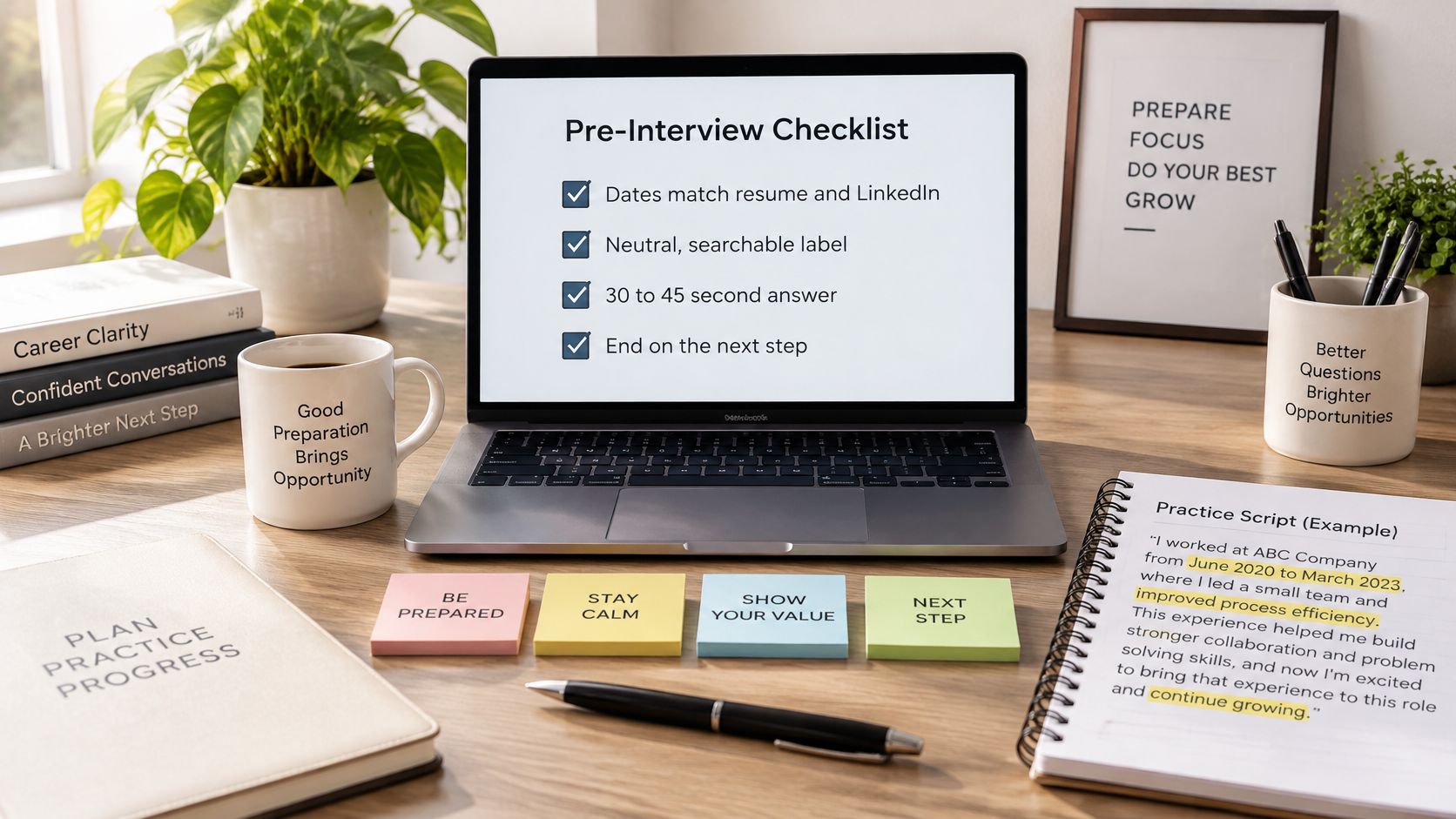
Your Pre-Application Checklist
- Dates match everywhere. Resume, LinkedIn, and application forms show the same months and years.
- Label is neutral and searchable. You've used a clear category, not a vague phrase or private detail.
- Spoken answer fits the target. You can deliver it in about 30 to 45 seconds without rushing.
- Answer ends on the role. Your last words cover availability, fit, or enthusiasm for this specific job.
- Resume treatment matches gap length. You've checked your period against the length table and added the right level of detail.
Say the answer out loud three times. Then record one run on your phone and listen once, specifically for filler words, rushed pacing, repeated apologies, and whether you return to the job quickly. Don't memorize it word for word. Memorized text breaks the moment an interviewer interrupts or rephrases the question. Aim for stable facts with flexible wording.
We rebuild interview pacing for career re-entry in low-stakes practice reps before real screens, because the first time you hear your own gap answer shouldn't be in front of a hiring manager. Our voice-based interview practice is scored on clarity, pacing, filler words, and content, based on a pasted job description. That feedback helps you hear whether your explanation sounds calm and current.
Use role-specific practice too. If you're moving into sales, reviewing prep for remote SDR interviews can help you connect your gap answer to prospecting, resilience, and communication questions. For broader rehearsal, work through our mock interview questions for job seekers and insert your gap line wherever the timeline comes up.
Don't practise until you can recite it perfectly. Practise until you can recover smoothly if the wording changes.
Capstone also has a career re-entry practice page with an in-depth look at the gap conversation. Use the tools that fit your situation, but don't delay the basic task. Write your one-sentence explanation today, say it out loud, fix the dates on your resume, and rehearse it once more before your next application.
Write your dated explanation today, then rehearse it out loud with feedback on clarity, pacing, filler words, and content before a real screen puts you on the spot. Visit Capstone Workforce to practise career re-entry answers in low-stakes reps suited to the job you want, so your gap becomes a brief fact and your readiness becomes the point.