How to Answer Strength and Weakness Question: 5 Examples
Capstone · November 11, 2026
Learn how to answer strength and weakness question with a clear structure, job-relevant examples and practice tips for honest, role-focused replies.
Your interview is Thursday at two. You've read the posting four times, you know the pay range, and you can talk through the last project on your resume without notes. Then someone on the panel leans forward and asks about your greatest strengths and weaknesses, and what comes out is the answer you've used since college. Strong communicator. Detail-oriented. A bit of a perfectionist.
Most candidates answer with adjectives. The interviewer writes something down, moves on, and you spend the rest of the day unsure whether the answer landed or evaporated. What sits underneath the question is a verification test, and interviewers know which checks they have available: the follow-up question, the work sample, the reference call.
They also register when preparation is missing. In a 2024 survey of 1,024 hiring managers by LinkedIn, 38% named appearing unprepared to answer basic questions as a top interview mistake, as CNBC's summary of the LinkedIn survey reports.
The question is also the opening candidates say they want. In a 2024 Harris Poll survey of 2,084 U.S. adults for Yoh, 54% said they would want to be asked what makes them a good candidate for a job, according to Yoh's survey findings. Treat it as the opening it is. Here's how to answer strength and weakness question in a form that still holds up after you stop talking.
Table of Contents
- The Four-Part Answer Structure at a Glance
- How to Choose and Prove a Strength the Role Needs
- Picking a Weakness That Won't Sink You
- Sample Answers for Two Different Candidates
- How to Rehearse and Score Your Answer
- Run the Final Check Before the Interview
The Four-Part Answer Structure at a Glance
A strong answer has two halves, and each half makes exactly one claim. The first names a competency the role explicitly needs and proves it with one example. The second names a real limitation you've already built a system around. No list of three strengths. No tour through your personality.
That shape isn't a personality quiz with better manners. Structured interviews predict performance more accurately and produce more consistent ratings across interviewers because the questions are tied to competencies identified through job analysis, as the federal Office of Personnel Management guide to structured interviews explains. The panel is scoring your evidence against a competency. Fluency earns nothing on its own, and neither does a beautifully told story that never shows what you personally did.
Where the middle of the answer collapses
Nearly every weak response fails in the same place. The candidate spends the first forty seconds on the company, the team, the season, the market, and then compresses the actions into a single sentence before landing on a result that sounds lucky. The interviewer hears a setting and an outcome with nobody visible in between.
Aim your spoken answer at 60 to 90 seconds and split it like this.
| Part | What to include | Share of spoken time |
|---|---|---|
| Context | One sentence on the setting, team or goal | 10% |
| Your responsibility | What you personally owned, not only what the team did | 15% |
| Actions | Two or three specific steps you took, in order | 55% |
| Result and reflection | A number or verifiable outcome, plus one lesson | 20% |
That split is the difference between sounding organized and sounding vague. The context sentence is a caption, not a chapter.
Here's the test that tells you whether the middle is there. After you finish, could the interviewer name the competency you demonstrated and the result you produced? If they couldn't repeat both back to a colleague an hour later, the actions section is what needs work, not your opening line.
Practical rule: if your answer could belong to any candidate with a similar job title, it isn't evidence yet.
The four parts are a template for evidence, not a script, so the same example reshapes cleanly. Lead with rerouting for a dispatch role. Lead with the escalation call for a customer success role. Keep the numbers, change the emphasis, and stop talking once the lesson connects to the job.
How to Choose and Prove a Strength the Role Needs
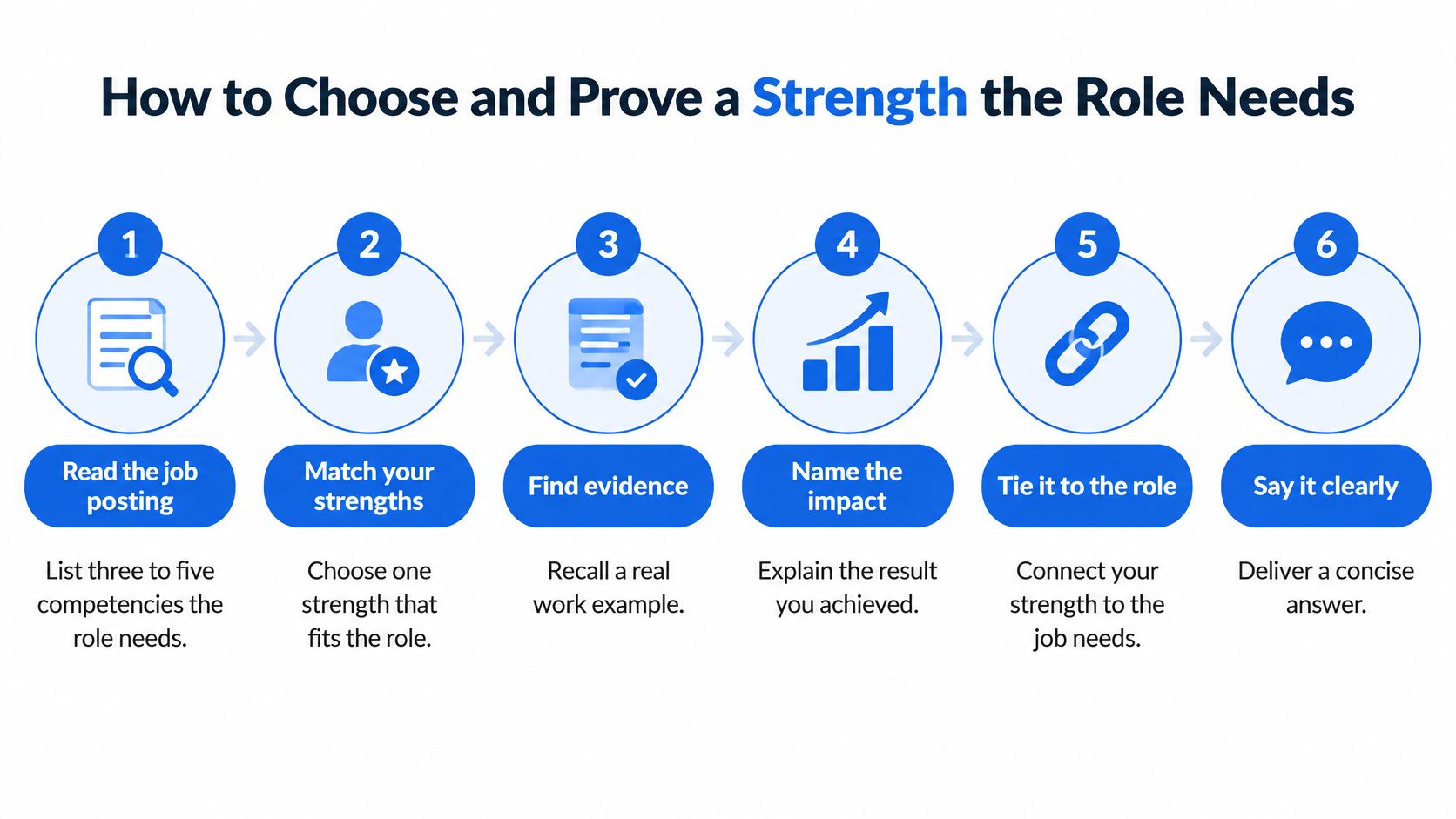
Pick the wrong strength and nothing later in the answer rescues it. Work through six steps and you'll land on a claim you can defend under questioning.
Read the posting and list three to five competencies. Prioritization, customer communication, quality control, whatever the description keeps returning to. You're answering against the rubric the panel wrote, not against your own highlight reel.
Score each competency against your own record. Pick the one with the strongest evidence behind it, and "evidence" means a specific day, task and outcome, not a private rating of nine out of ten.
Prepare two examples from different settings. One from a paid job, one from a volunteer role, a class project or a family business. A follow-up question then doesn't force you to repeat the same story with sharper adjectives.
Attach a number wherever one exists. Processing time cut by 15%. A project finished two days early. A satisfaction score that climbed after you changed a process. Numbers turn a claim into a record.
Run the verification test. Could a work sample, a skills test or a reference confirm this? If a former manager would hesitate for even a second, pick a different strength.
Write it as one sentence that ties the competency to the role. Name the capability, then connect it to what this job needs. That sentence becomes the first line of your spoken answer.
The organized trap
"I'm organized" is the most common strength answer and one of the weakest, because it's unfalsifiable as stated. A Connecticut workforce interviewing guide makes the point that generic claims such as "I work well with others" fail to distinguish candidates, and that interviewers want to know how a strength benefited an employer and how the candidate handled a real challenge.
So pair the adjective with an artifact. If you're organized, describe the tracking sheet you maintain, the Friday review you run, the handoff checklist you built. A process can be inspected. A trait can only be admired.
A strength you can't show is a preference. A strength someone else can confirm is a qualification.
If you want the fuller scene-by-scene walkthrough for building the example itself, the STAR method guide covers how to shape situation, task, action and result into something an interviewer can follow at speaking pace.
Picking a Weakness That Won't Sink You
The advice to choose a "safe" weakness has produced fifteen years of identical interviews. Perfectionism. Working too hard. Caring too much. Everyone in the room has heard it, and everyone knows it's a strength wearing a disguise. It reads as evasive, and evasive is a worse signal than an honest limitation.
What interviewers do with a safe weakness is press it. "When did that cost you something?" The answer collapses because there's nothing under it. A bounded weakness survives that follow-up because it has a real consequence attached.
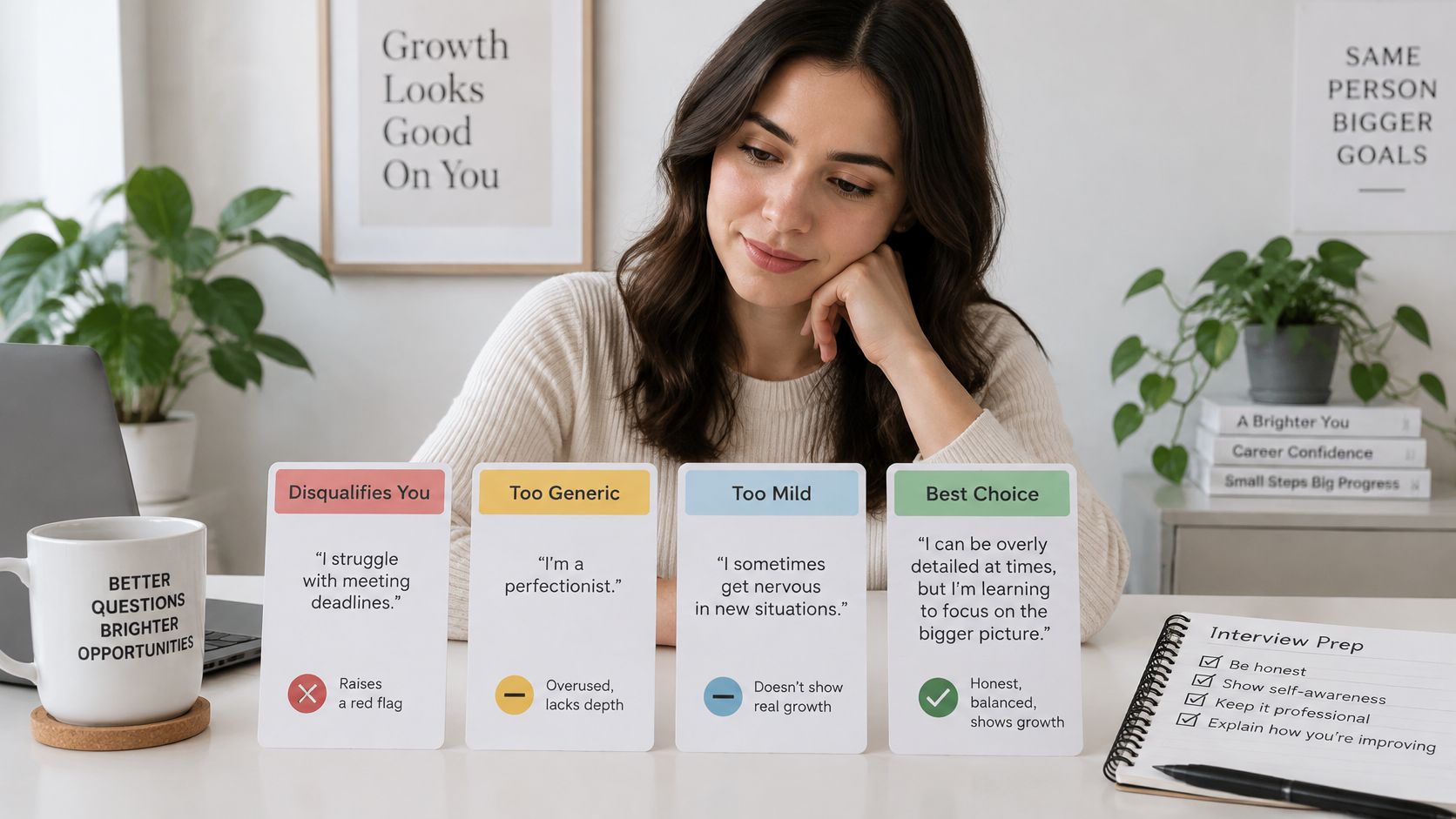
| Weakness type | How it is read | Example |
|---|---|---|
| Contradicts a core requirement | Disqualifies you for the role | Weak attention to detail for a quality-control job |
| Disguised strength | Reads as evasive | I work too hard |
| Unfixable trait | Gives no path to improvement | I have always been shy |
| Bounded behavior with a fix | Shows self-management | Delayed escalation on blocked tasks, now handled at a same-day checkpoint |
Finding a bounded behavior
Look at your last performance review, a piece of feedback a manager or peer gave you, or a target you missed. Pick a habit rather than a personality trait. Escalation timing, handoff documentation, meeting follow-up, the moment you decide a task is finished. Habits have dates and consequences, which is exactly what makes them credible.
Then build four moves into the answer. Name the specific behavior in one sentence. Describe its work impact with a consequence you can point to, not a feeling. Explain the corrective system you now use, such as a same-day checkpoint, an escalation rule or a standing agenda item. Close with evidence that it improved, ideally a before-and-after.
The rule I'd apply: the weakness must be something a new employer can live with for three months while you finish fixing it.
Skills gaps work well here because they're bounded by definition. Say the role uses a reporting tool you haven't touched. Name the course or practice project you've started, say where you are now, and give the point at which you expect to be proficient. That's a schedule, and schedules are checkable.
What sinks the answer is vagueness about cost. A weakness with no consequence sounds like humility practice. A weakness with a small, specific cost and a working fix sounds like someone who manages themselves.
Sample Answers for Two Different Candidates
Structure only becomes convincing when it's spoken. Two complete answers follow, each around ninety seconds at a normal pace, for two different roles. Read them aloud once; the shape is easier to copy by ear than by eye.
Maria, a retail shift lead applying for a dispatch coordinator role, on her strength.
"I'd point to rerouting work when plans break. As a shift lead I owned delivery sequencing for a store handling about 200 orders a week. On the Saturday of a holiday weekend our main truck arrived three hours late and two drivers called out. I pulled the manifest, re-sequenced 14 deliveries across two shifts by priority and distance, called the six customers with the tightest windows myself, and pushed two non-urgent pallets to Monday. Missed pickups dropped from nine the week before to four, and we closed the day without overtime. That's the part of dispatch I actually enjoy, because the plan always breaks somewhere."
One competency, her own verbs, a number, and a closing line aimed at the job she's applying for. She doesn't explain the retail chain, the weather or her manager's reaction. Every sentence is either her action or its effect.
Daniel, a former Army logistics specialist applying for a warehouse supervisor role, on his weakness.
"My weakness is delegation. The habit that stuck from the Army was checking every task myself before it moved. That worked when I had four items a day. During a battalion inventory audit it didn't, because I re-counted three sections the team had already verified and the audit ran two days long. My supervisor told me plainly that I was the bottleneck. I built a handoff checklist with a sign-off line for each section, and now I do one spot check per section instead of a full recount. The next audit closed on time, with the same accuracy result and roughly a third less of my own time in it. What I'm still working on is trusting the checklist on unfamiliar tasks, which is exactly what a supervisor role would test."
Both answers share four traits that make them survive scrutiny. The timelines are short and specific. Each covers one task rather than a whole career. Each has a before-and-after you could graph. And each ends by connecting the lesson to the target job rather than trailing off.
Notice what's absent. No blaming a coworker for the late truck. No claiming a personality transplant after one checklist. If you want to rehearse this format under time pressure, the mock interview question set puts the same structure against questions you haven't scripted.
How to Rehearse and Score Your Answer
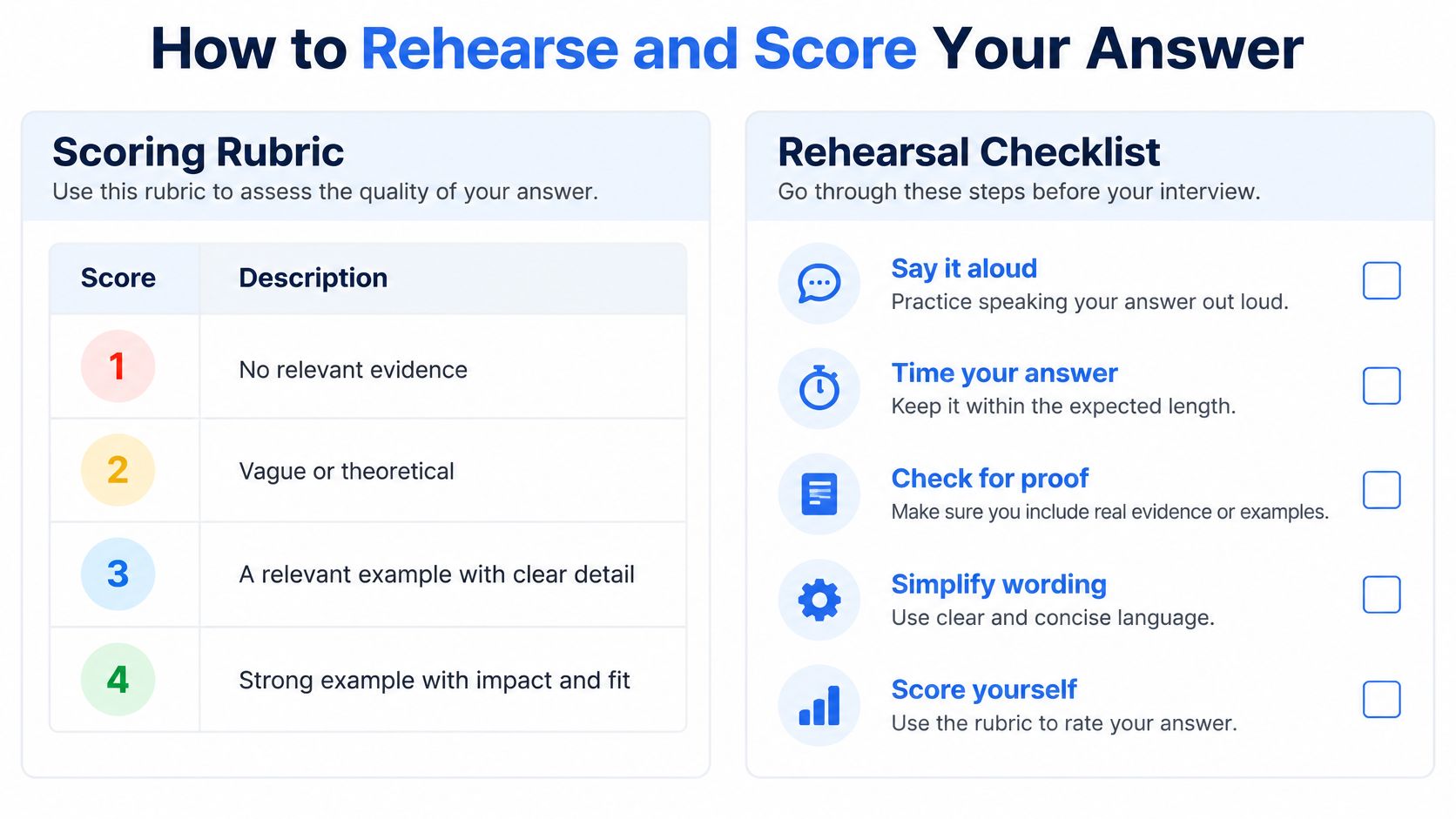
Treat this as a scoring problem rather than a confidence problem. Before you rehearse, know what a good answer looks like on paper, then grade yourself against it.
| Score | Evidence level | What it sounds like |
|---|---|---|
| 1 | No relevant evidence | I am a team player and a fast learner |
| 2 | Vague or mostly theoretical | I usually handle deadlines well |
| 3 | Relevant example with limited detail | I helped a coworker fix a schedule error last year |
| 4 | Specific personal actions plus credible result | I rebuilt the schedule myself and cut late shifts from six to two |
| 5 | Strong evidence matching the competency, with learning or repeatability | Same result over three quarters, and I now train new staff on the method |
That 1-to-5 scale mirrors how structured interviewers are trained to rate, where identical or comparable questions, job analysis and anchored rating scales are what keep scoring consistent, according to the Behavioral Scientist's guide to structured interviews. Aim for a 4 or higher on both answers before you walk in.
Knowing the scale and using it are different skills. In one compiled survey summary, 90% of hiring managers said interview preparation matters to a candidate's success, while only 44% of candidates practice answers to common interview questions and 32% of interviewees feel out of practice, as Zirtual's interview statistics roundup reports. The majority of your competition walks in unrehearsed.
The four-property audit
Record each answer on your phone, listen back once, and check four things.
- Ownership: count how many sentences start with "we." More than two and the interviewer can't tell what you did.
- Behavioral specificity: is there one real action with a date, a setting or a named tool, or is it all "typically" and "generally"?
- Verifiable consequence: is there a metric, a closed ticket or a delivered project that a reference could confirm?
- Transfer: does the lesson point at this job, or does it stop at the last one?
Run each property as if it were a verification attempt, because that is what it becomes in the room. Ownership and specificity are what a follow-up question probes. Consequence is what a reference call or work sample checks. Transfer is what the interviewer's scorecard rewards. An answer that reads as a 4 on paper but collapses the first time someone asks "and what did you do next?" is still a 2.
If you want the scoring done for you, a free interview coach practice run gives you 30 seconds to think and two minutes to answer a question out loud, then scores clarity, structure, filler words and pacing, and names one thing to say better. It shows the exact sentence to fix and lets you answer again until the answer lands, with no signup required.
Five failures to cut on the second take
Unsupported adjectives such as hardworking and passionate. Blame aimed at coworkers. A weakness with no mitigation mechanism. A claim of improvement with no before-and-after marker. Invented precision, like a statistic you can't source if asked.
Each failure is a verification gap dressed as an answer. Adjectives carry no evidence anyone can check. Blame invites a follow-up you can't win. An unsourced number collapses the moment someone asks where it came from.
Rehearsal target: practice until you can rebuild the evidence around a new question, not until the wording is memorized.
Reciting a script is what makes an answer fall apart the moment an interviewer rephrases the question. Knowing the evidence is what keeps it standing.
Run the Final Check Before the Interview
Three questions decide whether your answers are ready, and all three are about verification rather than delivery.
Does the strength name a competency this posting lists? Prioritization, customer communication, quality control, whichever appears first in the description. If it doesn't map to something the role needs, swap it.
Does the weakness stay clear of a core requirement? If the job is built on the thing you've named, the answer disqualifies you no matter how good the fix sounds.
Could each example be confirmed by someone other than you? Employers increasingly check claims in formats beyond conversation. A WGU report on AI and skills-based hiring lists general interviews at 41%, on-the-job evaluations at 40% and technical or skills assessments at 38% among the evaluation methods employers use. Your spoken claim needs to survive the task that follows it.
If any answer is a no, go back to the matching step: the strength procedure or the weakness selection. Then practice both answers aloud against a follow-up you didn't plan for. "What did you do after that result?" "Who could confirm this?" Time each run and keep it inside 60 to 90 seconds once you've cut filler and tightened the actions.
Finish by writing both answers on one index card, three keywords each: the competency, the number, the lesson. Glance at the card in the parking lot to recall the evidence, never to recite it. Before each new interview, swap in the competency the posting lists first so the strength stays relevant to the job in front of you.
Capstone Workforce builds interview practice around exactly this kind of evidence work. Our Interview Coach generates behavioral questions from the job posting you're targeting, lets you answer out loud, and scores clarity, structure, pacing and filler words before naming the one thing to fix, with the first question free and no signup. Run your strength answer, then your weakness answer, and rerun each until the evidence holds up under a follow-up you didn't write yourself.
Authored using the Outrank app