CNA Practice Test NC: Questions, Skills and Fees
Capstone · November 12, 2026
Work through a CNA practice test NC covering written questions, the five-skill exam, fees, retake rules and test-day logistics for 2026.
Can you pass the written test with room to spare and still walk out of the building without a credential? In North Carolina, yes. The written and hands-on parts of the exam are scored as two separate events, so a strong result on one tells you almost nothing about the other. That single fact reshapes how you should practice, and it's the first thing a solid study plan gets right.
People who search for CNA practice test NC options are often looking for a question bank, and they stop there. The exam doesn't work that way. Before you answer a single question, four things decide whether you get to the testing seat at all: your eligibility route, the physical requirements of the skills portion, what it costs to sit and to retest, and whether the date you booked will run. Get those wrong and perfect recall won't help you.
Table of Contents
- NC CNA Exam Parts at a Glance
- Choose Your Route Before You Practice
- Practice Questions for the Written Exam
- How to Rehearse the Five-Skill Test
- Exam Fees and Retest Rules
- Book the Exam and Track Readiness
NC CNA Exam Parts at a Glance
North Carolina's entry credential is the Nurse Aide I designation. You earn it by completing a state-approved training program and passing the National Nurse Aide Assessment Program competency examination, the NNAAP. Two components, two very different demands, one credential.
The written component is computer-based and multiple-choice, covering the knowledge side of aide work. The skills component is a live performance in front of an evaluator, and you don't choose what you perform: you're assigned five randomly selected skills. The North Carolina DHSR curriculum describes the skills portion as a 30-minute exercise that includes handwashing, one measurement skill, and three additional skills drawn from the NNAAP Candidate Handbook.
Thirty minutes for five procedures is tighter than it sounds once you count setup, supplies and cleanup. Handwashing alone has a required sequence of steps, and the evaluator watches each one.
| Component | Format | What it checks | Rule to know |
|---|---|---|---|
| Written exam | Computer-based, multiple choice | Safety, infection control, communication, resident rights, basic care | Scored separately from skills |
| Skills exam | Five randomly selected skills | Handwashing, one measurement skill, three more from the Candidate Handbook | 30 minutes total |
| NNAAP attempts | A limited number of attempts after approved training | Written and skills components | Once those attempts are used up, more approved training is required |
| Registry listing | North Carolina Nurse Aide I Registry | Completion of both training and testing | Initial listing runs for a set period before renewal rules apply |
Why the split matters more than the total score
Results come back as two separate outcomes, one for each component, and each must be passed on its own. Treat them as two exams sharing a single registration. A candidate who knows isolation procedures cold on paper still has to perform them in sequence, at a bedside, while being watched. That is a different skill, and it asks for a different kind of practice.
The state also builds in a limit and a clock. Approved training earns you a set number of attempts at the exam, and once they are gone, more state-approved training is required before you can sit again. Once training and testing are both satisfied, your name goes on the Nurse Aide I Registry for an initial listing period, after which renewal requirements take over. Every sitting counts, so walking in underprepared on either part costs you an attempt you cannot get back.
Practical rule: If practice material gives you questions and nothing else, it covers half the exam. A real benchmark pairs written questions on safety, infection control, communication, resident rights and basic care with a timed, five-skill performance drill run against the clock.
Two parts. Two scores. One listing at the end.
Choose Your Route Before You Practice
Route selection works like the first check before a patient transfer: you confirm the path is clear before you move. Some candidates searching for exam prep need a different exam, and a few do not need to test at all. North Carolina permits out-of-state nurse aides in good standing to apply for registry listing through reciprocity, according to the North Carolina DHSR nurse aide information page. Applicants who are not in good standing generally must complete an approved North Carolina training and competency pathway instead.
Reciprocity is also the point where candidates most often guess wrong. Qualifying depends on your standing on your current registry, how long you have held it, and what background checks the state asks for, and those specifics shift with each applicant's situation. Before you assume a transfer applies to you, confirm with the North Carolina Nurse Aide Registry which out-of-state aides qualify and what registry time and background checks your case requires.
| Your situation | First step | Practice focus |
|---|---|---|
| New trainee in an approved program | Finish training then register for the NNAAP | Full written and five-skill practice |
| Out-of-state aide in good standing | Apply for reciprocity listing | Documents and background check first; practice only if a test is still required |
| Out-of-state aide unsure of standing | Confirm eligibility with the North Carolina Nurse Aide Registry | Hold practice until the registry confirms your route |
| Aide not in good standing | Complete an approved North Carolina training and competency pathway | Full course content plus exam practice |
| Expired listing or missed work requirement | Retrain and retake the examination | Full written practice and timed skills rehearsal |
| Nursing student or military applicant | Confirm with the state which eligibility route applies | Ask the state which route applies before choosing a practice plan |
Find your row before you spend three weeks memorizing infection control. An interstate aide whose application is still pending is waiting on paperwork, while an aide whose listing lapsed cannot sit for the exam tomorrow no matter how well they score on practice questions.
Your confirmed route also tells you how much of the exam you owe. A reciprocity approval can remove testing entirely, while a lapsed listing puts both halves back on your plate, so the written and skills sides of your prep only matter once you know each one is required. If you are new to the state system entirely, the North Carolina CNA guidance walks through the sequence from training to registry.
Practice Questions for the Written Exam
The written exam is a minimum-competency test for an entry-level aide. That word, minimum, is your study brief: it rewards the safest ordinary action, not the most elaborate one. Build questions around six areas, and rotate through all six rather than living in your favorite.
- Safety and emergency response: fall prevention, fire response, choking, seizure care, what to report and how fast.
- Infection control: when hands get washed, glove order, standard versus transmission-based precautions.
- Communication: what you say to a resident, how you report a change to the nurse, what belongs in the chart.
- Resident rights: refusal of care, privacy, dignity, abuse reporting, personal choice.
- Basic care: bathing, grooming, feeding, elimination, positioning.
- Standard bedside procedures: transfers, range of motion, vital signs, and doing them in the right order.
Try these four. Cover the answers first.
1. A resident's call light comes on while you're passing lunch trays. What do you do first? A. Finish the tray round, then answer the light B. Answer the light, tell the resident when you'll return, and get help if the need is urgent C. Note the light and answer it after the meal service D. Ask another aide to check it at the end of the round
Answer: B. Prompt response and a clear time frame come before task completion.
2. When is hand hygiene required during a care procedure? A. Before resident contact only B. After resident contact only C. Before and after contact, and again after removing gloves D. Only when hands are visibly soiled
Answer: C. Gloves are not a substitute for handwashing, and the sequence is checked on the skills side too.
3. A resident who uses a walker refuses a shower this morning. What's the right response? A. Explain the risks and insist, because hygiene is part of the care plan B. Respect the refusal, offer an alternative, document it, and report it C. Ask a coworker to persuade the resident D. Skip documentation because no care was given
Answer: B. The right to refuse care is a resident right, and a refusal is still a reportable event.
4. You notice water on the bathroom floor. What do you do? A. Tell housekeeping at the end of your shift B. Lay a towel over it and continue C. Clean it up immediately and report the hazard D. Ask residents to avoid that bathroom
Answer: C. A wet floor is a fall risk, and fall prevention doesn't wait for someone else's shift.
Keep two logs, not one
Track written and skills results separately. For the written side, record the topic of every missed question in a simple list, then review that topic before you retest it. Don't rerun the entire set to feel better; rerun the weak area to get better.
Set a mastery target you choose yourself, such as sustained high scores across several full timed forms, rather than a single lucky pass. Repeated misses in one area are a content gap. Study it. Memorizing the answer key teaches you nothing you can use at the bedside.
How to Rehearse the Five-Skill Test
The skills side is scored as a performance. An evaluator stands in the room and checks each step on a list while you work. You won't know which five skills you've drawn until test day, the whole run happens against a single clock, and handwashing is always in the mix. Build a routine you can repeat until the steps run in order without prompting.
Run this loop twice a week for a month.
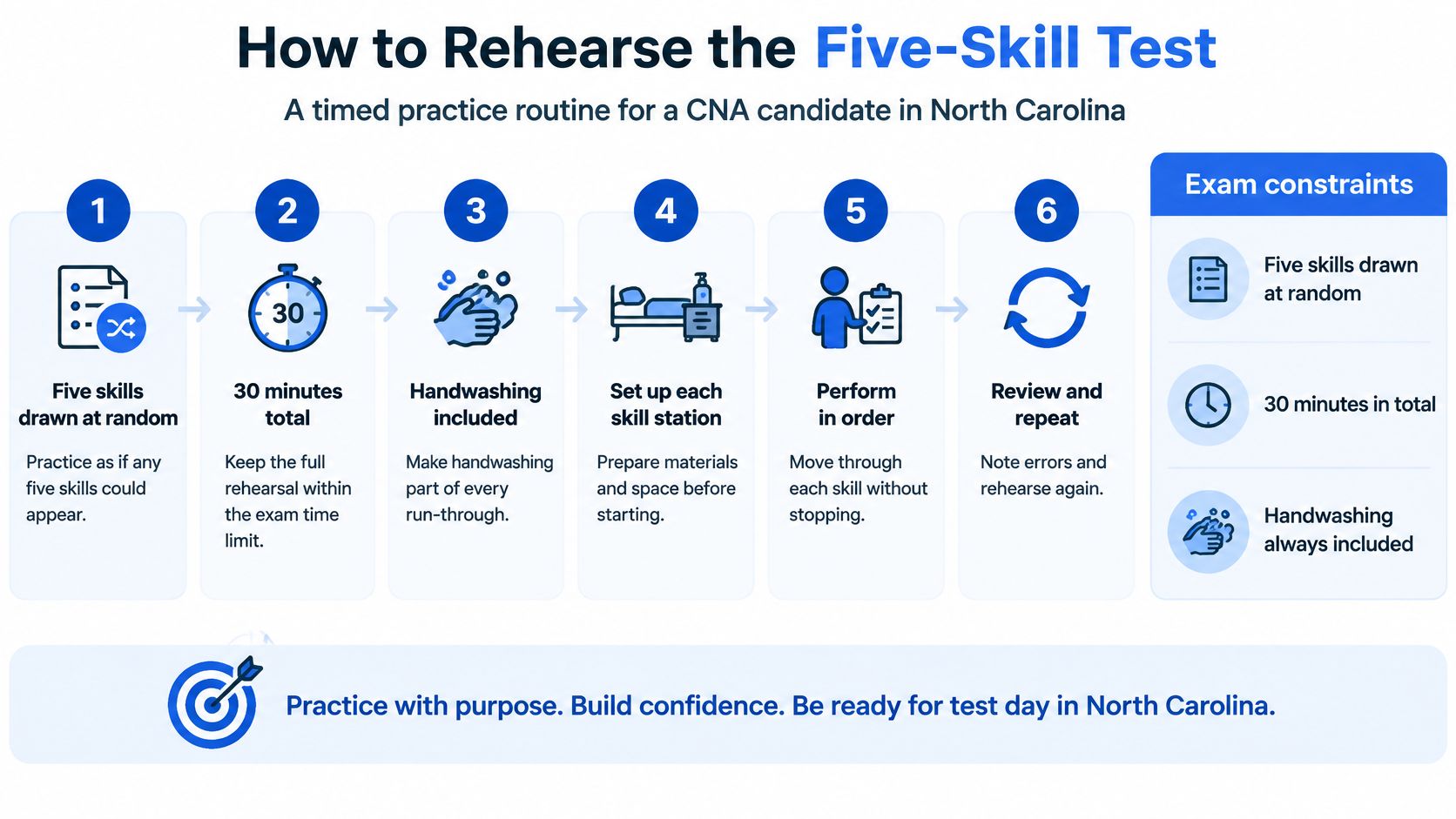
- Pull the official skills list. Work from the NNAAP Candidate Handbook, not a video or a classmate's notes, because the evaluator scores against those exact steps. Mark which skills need equipment; setup eats your clock.
- Time your handwashing on its own. Wet, soap, scrub, rinse, dry, in that order, with a visible timer. It is always one of your five, so it earns solo reps before it ever joins a full run. The common slip is rushing the scrub or drying on a paper towel that's already wet.
- Rehearse the measurement skill out loud. Name each step as you perform it, including reading the value and recording it. Speaking the steps keeps the narrated checkpoints from going silent under nerves. The slip here is measuring without narrating and then guessing at the result.
- Draw three more skills at random. Have a partner pick them without telling you in advance, then run all three in mixed order. The slip is practicing your favorites; the draw on test day won't match your preferences.
- Run the full five-skill sequence inside the exam's time limit with a clock in view. Handwashing leads the run as its own scored skill, followed by the four you drew. The slip is a polished first skill and a frantic fifth.
- Get scored against the handbook steps. An instructor or experienced aide marks each checkpoint, including indirect behaviors like identifying the resident, explaining the procedure, providing privacy, and leaving the bed in a safe position. These carry points even when the procedure itself goes smoothly.
- Repeat only the steps you missed. Mark the exact checkpoint that failed, drill that step in isolation, then run the full sequence again on the next pass. Rehearsing an entire skill to fix one forgotten checkpoint spends the session on steps you already own.
Watch for the quiet failures. Explaining the procedure while performing it is scored, and skipping hand hygiene before handling clean supplies can sink a skill you otherwise executed perfectly.
A ready candidate looks boring from the doorway: five skills in order, inside the time limit, every safety checkpoint hit without a reminder. If you want the full breakdown of every procedure before you start drilling, the CNA skills list for North Carolina candidates lays out each step.
Exam Fees and Retest Rules
Budget before you book, because a failed section is a bill, not a do-over. North Carolina bills the written or oral exam and the skills evaluation as separate parts, and the dollar amounts are set by the state's testing program, so confirm the current fee for each line on the official nurse aide testing and registry pages before you schedule. What you can plan around right now is the structure itself.
| Charge | Applies to |
|---|---|
| Initial Nurse Aide I exam | Written or oral exam plus skills evaluation |
| Written or oral retest | Retaking only the written or oral portion |
| Skills retest | Retaking only the skills evaluation |
That split is the useful part. A failed written exam never forces you to repay for skills, and a failed skills evaluation never costs you another written attempt. Your result comes back per part, so the score itself tells you which half of your preparation needs work.
A worked example, because the attempt count surprises people
Say you pass the written portion on your first sitting and fail the skills evaluation. You pay the skills retest fee and try again. Another miss. Two of your three NNAAP attempts are now gone. One remains, and after that, additional state-approved training is required before you can test again. The lesson here is bigger than the dollar figure. Every skills retest spends a fee and an attempt, so the five-skill rehearsal belongs before the test date, not after a failure.
Budget rule: Plan for the initial fee plus at least one retest, and schedule your skills practice before the exam date rather than after a failed attempt.
The fees aren't the only thing that expires. Registry listing requires at least eight hours of qualified paid work involving nursing or nursing-related services under RN supervision during each 24-month listing period, according to the North Carolina curriculum materials. Aides who miss that requirement retrain and retake the examination. If you are weighing programs before you commit, this CNA training cost breakdown puts the fees in one place.
Book the Exam and Track Readiness
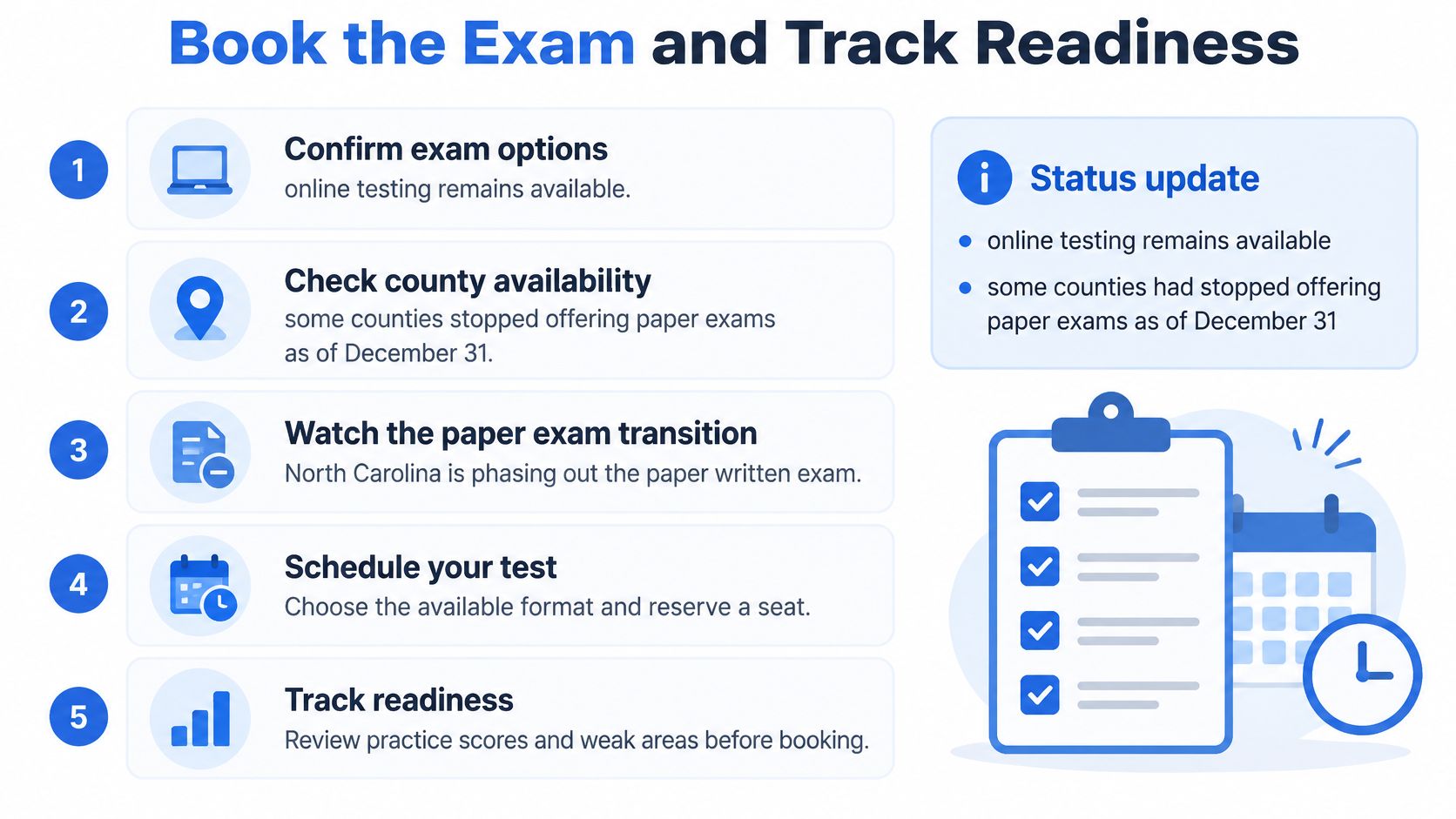
Knowledge readiness and operational readiness are two different things, and only one of them can be fixed by studying. North Carolina is phasing out the paper written examination while online testing remains available, and as of December 31, 2024, some counties had already stopped offering paper exams, according to the North Carolina Nurse Aide Registry quick reference guide. Confirm the format your county offers before you study for the wrong one.
Scheduling also works differently from what candidates expect. Skills evaluations run as scheduled group events rather than walk-in appointments, so a date can be moved or canceled if the event doesn't fill or isn't requested early enough. A candidate who is academically ready can still lose weeks waiting for the next session.
Work through the sequence in this order:
- Confirm your eligibility route using the table earlier in this guide, so you're not preparing for an exam you don't need.
- Confirm your county's format and whether a skills event is scheduled near you.
- Book the earliest date you can realistically prepare for, leaving enough lead time for the event to be confirmed.
- If you're testing online, test your setup. Check the computer, webcam, and internet connection, and find a quiet room with a door you can close.
- Pick a backup date and location, and sort out transportation now rather than the week of.
- Practice both tracks every week, written topics and timed five-skill drills, and keep the two scores in separate logs so you can see which one is lagging.
That last step deserves emphasis. A strong written score tells you nothing about whether you can perform a skill within the time limit, and a smooth skills run says nothing about your knowledge gaps. Two logs, two separate verdicts.
Capstone Workforce's certification prep covers both halves: written practice tests and step-by-step skills practice you can perform aloud and check against each required step. If training cost is the obstacle, the free WIOA Navigator reads your eligibility in about 60 seconds, names your state's intake path, lists the documents to bring, and gives you six questions to ask at the first appointment, with no signup required. Local workforce boards decide funding eligibility, so treat any funding answer as a starting point rather than an approval. You can start at Capstone Workforce.
Before you pay anyone a fee, verify current registration details through North Carolina's official resources.